

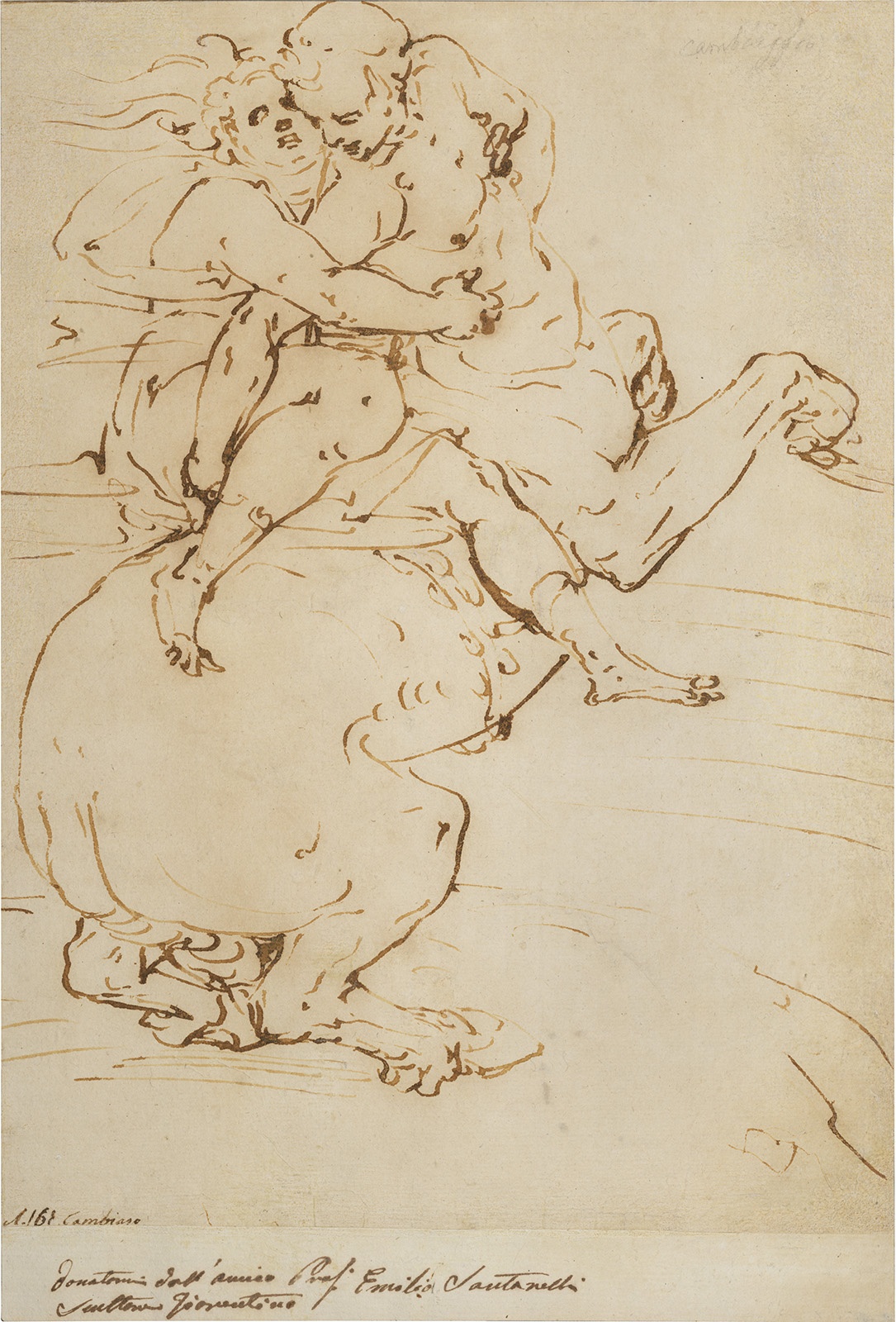
Luca Cambiaso
(Moneglia, 1527 - Madrid, 1585)
Rape of Dejanira, 1560-1565
Pen and brown ink on white paper
325 x 240 mm (12.80 x 9.45 inches)
Luca Cambiaso
(Moneglia, 1527 - Madrid, 1585)
Rape of Dejanira, 1560-1565
Pen and brown ink on white paper
325 x 240 mm (12.80 x 9.45 inches)
Re: 0272
Iscriptions
"cambiaggio", pencil, in top, right
"N. 161.Cambiaso", pen, in below, left
"Donatomi dall'amico Prof. Emilio Santarelli/scultore fiorentino", pen. in below, on the backgroup
"1428" pencil, in top, left, on the backgroup
Provenance
Florence, collection Emilio Santarelli, post 1840 - before 1866
Genova, collection Santo Varni, post 1860 – before 1885 (?)
Milan, Gallery Sambon, 1887 (?)
Milan, Finarte, 21 april 1975, lotto 91
Private collection
The drawing depicts the Rape of Deianira, a celebrated episode from Ovid’s Metamorphoses (IX, 101–133). The composition is orchestrated along a diagonal axis of pure dynamism, in which the hybrid anatomy of the centaur and the contorted limbs of the nymph fuse into a single, tightly knit plastic tangle. Nessus twists round upon himself with a powerful thrust of his hindquarters and is caught at the moment of carrying off Deianira. Held by force on the creature’s back, she struggles desperately to break free, her head thrown back, her hair streaming in the wind and her face contorted in a scream of terror.
The drawing re-emerges today from a private collection, bearing valuable traces of its history. The exact sequence of owners before the Finarte sale in Milan on 21 April 1975, where the sheet was offered as a work by Luca Cambiaso, remains unknown. Nevertheless, the inscription at the foot of the sheet allows it to be traced back to the distinguished collection of the Florentine sculptor Emilio Santarelli (1801–1886),¹ who had taken up collecting around 1840, following the example of François-Xavier Fabre.² The title ‘Prof.’ preceding his name in the inscription places the gift in the years when Santarelli was already an established teacher. This was almost certainly after 1860, the year in which he was appointed to a professorship at the Accademia di Belle Arti in Florence. In 1866, moreover, Santarelli formalised the donation of his collection of works on paper to the Uffizi, a monumental corpus of more than twelve thousand items.³ The gift was sealed by a printed catalogue, published in 1870 and edited by Emilio Burci and Ferdinando Rondoni, which, however, lists no drawing attributed to Cambiaso.â´
The mark ‘N. 161’ in the lower left corner, like the dedicatory inscription below it, is not to be ascribed to Santarelli’s inventory. Rather, it finds suggestive palaeographic parallels in notes found on a group of sheets from the collection of the Genoese sculptor Santo Varni (1807–1885).âµ This raises the possibility that the sheet was removed from the portfolio and given away privately before the transfer to the Uffizi in 1866, which establishes a secure terminus ante quem for the circulation of the work. Furthermore, the words ‘scultore fiorentino’ (Florentine sculptor) added after the donor’s name point to a recipient from outside Tuscany, which fits the profile of the Ligurian artist. Trained in his youth in Florence under Lorenzo Bartolini, Varni maintained close ties with Tuscan circles. Between 1837 and 1860 he carried on an intense correspondence with Santarelli, enriched, not by chance, by significant exchanges of works of art.ⶠIn 1850, for instance, Santarelli sent him a portrait head of Michelangelo and a relief with a Madonna by Donatello.â· In 1860 the two acted together as intermediaries in the sale of a sculpture of Bacchus by Luca Cambiaso, now identified with a statue in the Museo Nazionale del Bargello.â¸
It is thus clear that Varni was not only a renowned sculptor but also an erudite and omnivorous collector, fully engaged with the mid-nineteenth-century art market. His was indeed a vast and eclectic collection of more than five thousand pieces: archaeological finds and modern marbles, maiolica and medals, paintings and bozzetti, drawings and miniatures, printed books and manuscripts. He even went so far as to acquire arms of various kinds.â¹ A tireless scholar of Liguria’s historical heritage, he took a particular interest in his fellow Ligurian Cambiaso, by whom he owned dozens upon dozens of drawings.¹â° These were later dispersed at the sale of his estate held at the Galleria Sambon in Milan in 1887.¹¹ On that occasion no fewer than twenty-nine lots containing sheets assigned to the master from Moneglia went under the hammer, unfortunately without any indication of their subjects.¹² Despite the uncertainty caused by the catalogue’s reticence, everything suggests that Santarelli parted with this drawing in order to give it to his friend Varni. As a colleague of such kindred intellectual outlook, Varni would surely have appreciated its merit.
Turning now to style, the sheet, hitherto unpublished, should be confirmed as the work of the Genoese master. It is a paradigmatic example of his distinctive graphic grammar, celebrated for its eccentricity and its vibrant handling of ink. As is customary with him, the line, drawn with a rapid, cursive ductus, does not merely model the volumes but probes the movement of the scene. It does so through a continuous stroke that becomes the driving force of the representation. Concealed within it is a learned borrowing from the Conversion of Saint Paul engraved by Enea Vico in 1545 after a design by Francesco Salviati. As scholars have noted,¹³ Cambiaso held Vico’s monumental print in deep admiration. He quoted its spirited horse verbatim both in the contemporaneous Warrior on Horseback in the Istituto Nazionale per la Grafica, Rome,¹â´ and in the countless variants he devoted to the Conversion of Saint Paul.¹âµ It is from this singular visual reflection that the springing hindquarters of the centaur Nessus derive. They generate an agitated narrative rhythm and a formal synthesis closely consonant with the celebrated study of Aeneas Fleeing Troy with His Family in the Musée du Louvre, Paris, which scholars have placed in 1562–1563.¹â¶ The Rape shares with the latter a marked ability to energise the scene through pen work alone. In this pen work emerge the first signs of the geometric, proto-Cubist fragmentation that would soon make his style unique.
To further corroborate the autograph status of the work, one must look once again to the rich holdings of the Louvre, which preserves some of the cornerstones of the artist’s graphic production. The lightness of touch closely recalls the treatment of the Virgin and Child datable to the late 1550s.¹â· The dishevelled rendering of Nessus’s hair and the exaggerated musculature of his torso, for their part, reveal suggestive affinities with the study of a Kneeling Man.¹â¸ The vigorous foreshortening of Deianira’s face and her limbs, defined by broken, concise slashes of ink, patently echo the incisiveness of the flying angel in the Annunciation, datable to around 1565.¹â¹ To these may be added other key expressions of the same formal sensibility. The definition of the muscle groups and the tension of the line recall the various versions of Sibyls in the Princeton University Art Museum (fig. 1), the Staatsgalerie Stuttgart and the Nationalmuseum, Stockholm (fig. 2).²â° The airy rhythm that pervades the composition, in turn, brings the sheet close to the results achieved in the Diana and Callisto in the Fogg Art Museum, Cambridge, Massachusetts.²¹ This stylistic evidence suggests placing the drawing between 1560 and 1565. In those years Cambiaso tempered the Michelangelesque exuberance of his early career in favour of a more measured idiom, nourished by the learned linearism of Perino del Vaga.²²
The intended destination of the invention, by contrast, remains difficult to identify, given the loss of most of the façade decorations and secular frescoes executed by the artist. Nevertheless, its eminently theatrical character, the perspective conceived for viewing di sotto in sù and the mythological subject suggest that this is a first idea for the fresco decoration of an aristocratic Genoese palazzo. Ovid’s fables were, after all, the favoured repertory for adorning the friezes, lunettes and vaults of the city’s sumptuous residences. The painter’s campaigns at Palazzo Doria-Spinola and Palazzo Grillo document this well.²³ The theme of abduction and mythological hybris runs throughout the master’s career, lending itself to compositions of extreme virtuosity. Examples include the Rape of Proserpina, conceived around 1560–1563 for the ceiling of Vincenzo Imperiale’s residence in Campetto, and the Rape of the Sabine Women, painted in 1565–1566 for the Villa Cattaneo-Imperiale at Terralba.²â´
Fig. 1. Luca Cambiaso, Sibyl, c. 1555–1560. Princeton, Princeton University Art Museum
Fig. 2. Luca Cambiaso, Sibyl, c. 1555–1560. Stockholm, Nationalmuseum
¹ Bietoletti 2017, pp. xxx.
² Salvagnini 2003, pp. 3–14.
³ Disegni italiani 1967; Moral 2016, pp. 63–77.
â´ Catalogo 1870.
âµ Santo Varni 2018; Olcese Spingardi 2025, pp. 71–81. See, for example, lots 1–37 sold by Cambi in Genoa on 18 March 2021, comprising drawings formerly owned by Varni.
ⶠAlba, Fondo Santo Varni, 25 (Lettere di scultori, L–Z), fasc. ‘Emilio Santarelli’.
â· Zurla 2018, pp. 54, 64, n. 19.
⸠Fontanarossa 2014, pp. 729–734.
â¹ Olcese Spingardi 2018, pp. 227–236.
¹â° Fabbri 2018, pp. 246–247 and passim.
¹¹ Catalogo 1887.
¹² The sheets were auctioned both unmounted, in portfolios and albums (lots 1073–1074, 1076, 1103–1104, 1106, 1111), and mounted in frames (lots 1114, 1116, 1119–1120, 1123, 1127–1129, 1131, 1133, 1135, 1137, 1140, 1142–1147, 1149–1150).
¹³ Bober 2006, pp. 81–82.
¹â´ G. Fusconi, in Disegni genovesi 1980, p. 17.
¹âµ J. Bober, in Luca Cambiaso 2006, pp. 232–233, 314–315, nos 11, 51.
¹â¶ Bober 2006, pp. 81–82, fig. 14 and p. 90, n. 47; Mancini 2010, pp. 68–69, no. 16.
¹â· Mancini 2010, p. 66, no. 8.
¹â¸ Mancini 2010, p. 67, no. 11.
¹â¹ Bober 2006, p. 82; Mancini 2010, p. 71, no. 25.
²â° J. Bober, in Luca Cambiaso 2006, pp. 248–253, nos 19–21.
²¹ J. Bober, in Luca Cambiaso 2006, pp. 285–286, no. 39.
²² Bober 2006, pp. 80–84.
²³ Suida Manning, Suida 1958, pp. 74–76, 80, 85–86; Magnani 1995, pp. 22–37, 46–50.
²â´ Suida Manning, Suida 1958, pp. 88, 176, 190; Magnani 1995, pp. 59, 101; J. Bober, in Luca Cambiaso 2006, pp. 290–291, 310–313, nos 41, 49–50.