

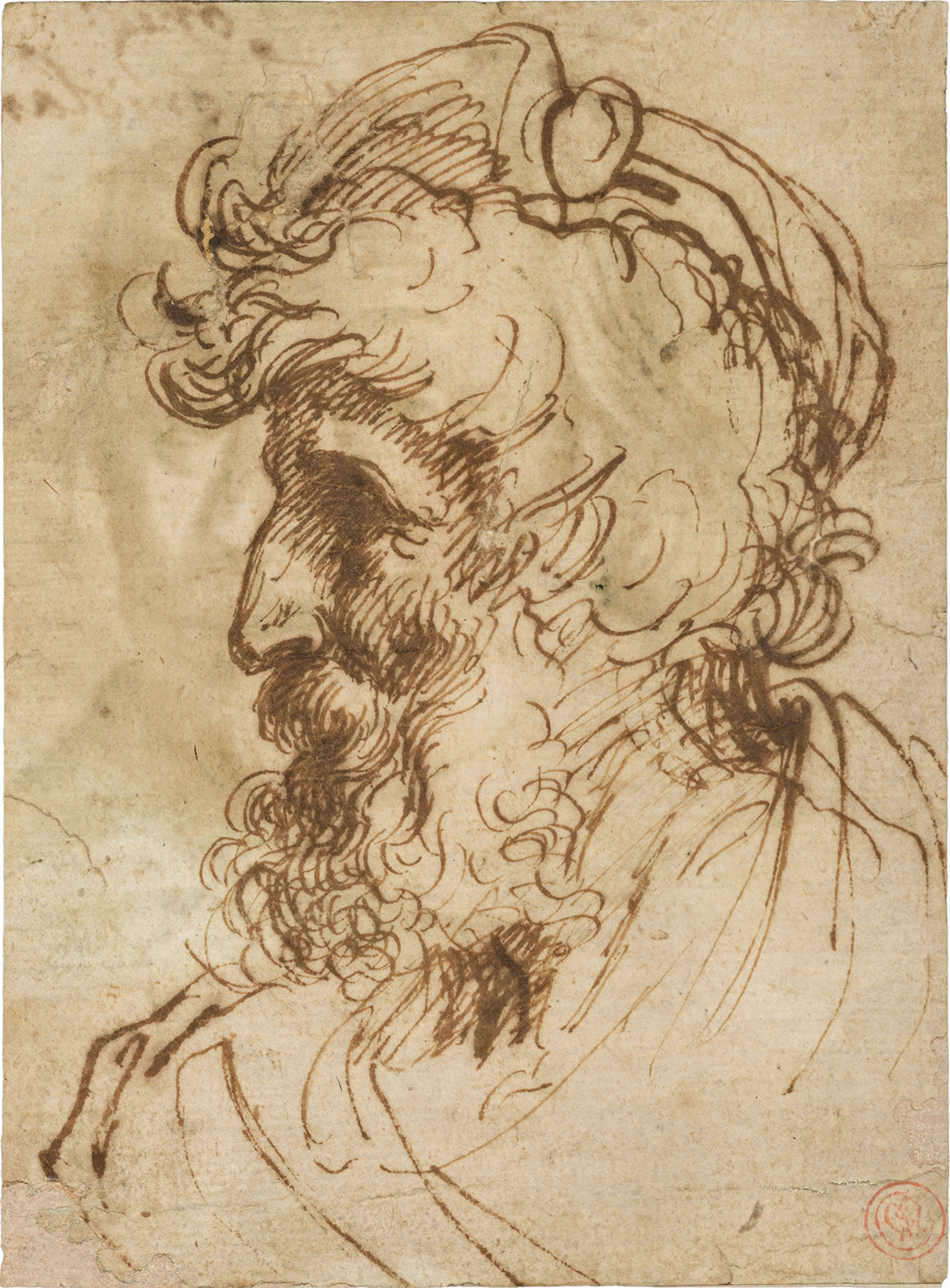
Agostino Carracci
(Bologna, 1557 - Parma, 1602)
Study of a Bearded Head (Gneo Marcio Coriolano),1595-1600
Pen and brown ink on paper
122 x 90 mm (4.80 x 3.54 inches)
Agostino Carracci
(Bologna, 1557 - Parma, 1602)
Study of a Bearded Head (Gneo Marcio Coriolano),1595-1600
Pen and brown ink on paper
122 x 90 mm (4.80 x 3.54 inches)
Re: 0273
Iscription
«Parmiggianino», pencil, below, left, on the backgrounp «Coriolano», pen, top, left, on the verso
Collector's mark
Charles Henri Marcelli (Lugt 609), red ink, below, right
Raffaello Ettore Lamponi Leonardo (Lugt 1760), blue ink,on the backgrounp, to center
Provenance
Liegi, collection Charles Henri Marcellis, first half XIX sec.
Florence, collection Raffaello Ettore Lamponi Leopardi, before 1902
Florence, Borgo Pinti [Sambon], 13 november 1902, lotto 570
Milano, Finarte, 3 december 1975, lotto 45
Private collection
Letterature
N. Ferri, in Catalogue 1902, p. 26, n. 570
Executed in pen and brown ink with a vibrant, concise ductus, the sheet presents the proud profile of a bearded man turned to the left, his head encircled by headgear that may be read as an all’antica helmet. The intensity of the chiaroscuro, concentrated in the deep eye socket and in the dense tangles of strokes in the beard, lends the face an expression of severe gravitas, typical of martial portraiture of classical descent. The key to the subject’s identity lies in an inscription concealed on the verso. The drawing is laid down on a backing card whose removal would have compromised its integrity, so non-invasive diagnostic investigation was required to read the inscription. False-colour and UV fluorescence photography made it possible to decipher the word ‘Coriolano’, written next to a sketch of a head in frontal view that is harder to make out. This evidence seems to invite identification of the figure on the recto as the legendary Roman commander Gnaeus Marcius Coriolanus. A general and statesman of the fifth century BC, he was famed for having captured the city of Corioli. Exiled from Rome for his contempt of the plebs, he went over to the enemy Volsci and marched with them against his own homeland, halted only by the entreaties of his mother Veturia. The grim, almost feral physiognomy and the agitation of the line accord with the martial fury and intransigence that historians ascribe to the patrician hero, giving visual form to his implacable ethos.
Two collector’s marks, stamped on the recto of the drawing and on the backing on the verso, allow the provenance of the sheet to be traced at least as far back as the early nineteenth century, when it belonged to Charles Henri Marcellis (1798–1864), a Belgian lawyer, poet and member of parliament.¹ In addition to his political and literary activity, Marcellis played a central role in the industrial life of his time. He founded several ironworks, an activity that in 1844 led him to develop the so-called ‘Belgian system’, which revolutionised the construction of cast-iron bridges.² Very little is known, by contrast, about the extent and formation of his collection. We know only that around the middle of the century a number of sheets passed into the collection of Colonel Count Raffaello Ettore Lamponi Leopardi (c. 1820–1902).³ A prominent figure on the Florentine scene in the second half of the century,â´ the count collected works of art of every kind, with a particular predilection for paintings and drawings by the Old Masters. He did not neglect sculpture either, as the Pazzi Madonna by Donatello attests: now in the Bode-Museum, Berlin, it was recorded in the colonel’s possession in 1886.âµ As our sheet also confirms, a substantial part of his collection of drawings came precisely from the group once owned by Marcellis. On the count’s death, his vast collection was dispersed at the auction organised by the Milanese dealer Giulio Sambon in Borgo Pinti, Florence, from 10 to 19 November 1902. The sale stood out for the sheer scale of its offering, no fewer than 2,625 lots, described in a lavish illustrated catalogue. The catalogue was compiled with the collaboration of Professor Nerino Ferri, curator at the Uffizi, a testament to the prestige and quality of the sheets assembled by Lamponi Leopardi. It was during that memorable sale, on 13 November, that our drawing appeared at auction with an attribution to Parmigianino.â
This illustrious attribution does justice to the sustained quality of the sheet. From a strictly stylistic point of view, however, the reference to Parmigianino is entirely untenable. The graphic features point instead to a later date, around the end of the sixteenth century, and to a ductus that leads straight to the Carracci. It is thus no coincidence that the sheet, which vanished from sight after the Sambon sale, resurfaced in Milan at Finarte on 3 December 1975, this time correctly attributed to Agostino Carracci. To my knowledge this attribution has never been taken up in the literature on the Carracci. It is still supported, first and foremost, by the peculiarities of the style. Agostino’s hallmark is clearly evident in the vibrant definition of the curls of the beard and the locks of hair. Above all, it is evident in the fluency of the unbroken line: the pen is almost never lifted from the paper, producing a distinctly calligraphic quality, especially in the description of the headgear. Unlike his brother Annibale, with his more rigorously naturalistic approach, Agostino relies here on sinuous contours and on an idiom in which details such as beard and hair tend to resolve into virtuoso, ornamental flourishes. He concentrates the stroke instead in exploring the chiaroscuro around the eye socket.
In this respect, it should be made clear that we are not dealing with a caricature exercise. Agostino practised that genre extensively to hone his manual dexterity and to create virtuoso optical games,â· but this is rather a physiognomic study of a figure from Roman history, sketched in profile in all his severe gravitas. This type of image does not so much reflect the finished composure of other all’antica heads, such as the Titus in the Nationalmuseum, Stockholm. Rather, it finds a closer affinity with, for example, the bearded male profile facing left at the top of another sheet in the same Swedish museum (fig.).⸠In both cases Agostino dwells on the lively, animated rendering of the locks and outlines the garments with extreme concision, giving only a rapid indication of the drapery. The same modus operandi can be seen in the boy sketched in profile on a sheet of Landscape Studies now in the British Museum, London.â¹
This capacity for expressive synthesis would become a recurring refrain within the family workshop, beginning with his brother Annibale. The celebrated study for the Self-Portrait on an Easel in the Royal Collection at Windsor, of around 1603–1605, shows this clearly.¹â° Yet if this comparison confirms a shared cultural root, it also reveals the profound stylistic differences between the graphic corpora of the two brothers. Our sheet betrays Agostino’s taste for broad linear phrasing, swelling contours and a rhythmic handling in some respects close to the aesthetics of engraving.¹¹ Annibale’s study at Windsor, by contrast, displays the distinctive, austere economy of means typical of his mature phase. In Annibale the stroke becomes deliberately shorter and straighter, gesturally ‘staccato’, that is, free of any linear excess or decorative flourish. Yet these are the very elements that make Agostino’s graphic breadth unmistakable. To him, therefore, belongs this masterly effigy of Coriolanus.
¹ Lugt 1956, no. 609, s.v. ‘Marcelli, C.’; in the 1921 edition it appears as ‘marque non identifiée’.
² Dewalque 1895, pp. 425–429; Verswijver, Wouters, Bertels, De Kooning 2011, pp. 209–220.
³ Lugt 1921, no. 1760, s.v. ‘Lamponi, R.’.
â´ Bertelli 2012, p. 269.
âµ Cavallucci 1886, pp. 32–33.
ⶠN. Ferri, in Catalogue 1902, p. 26, no. 570.
â· On this subject see Vaccaro 2024, pp. 103–125.
⸠Bjurström, Loisel, Pilliod 2002, nos 1460, 1373.
â¹ Turner 1980, no. 36.
¹â° Wittkower 1952, no. 353.
¹¹ See also Wittkower 1952, no. 152.