

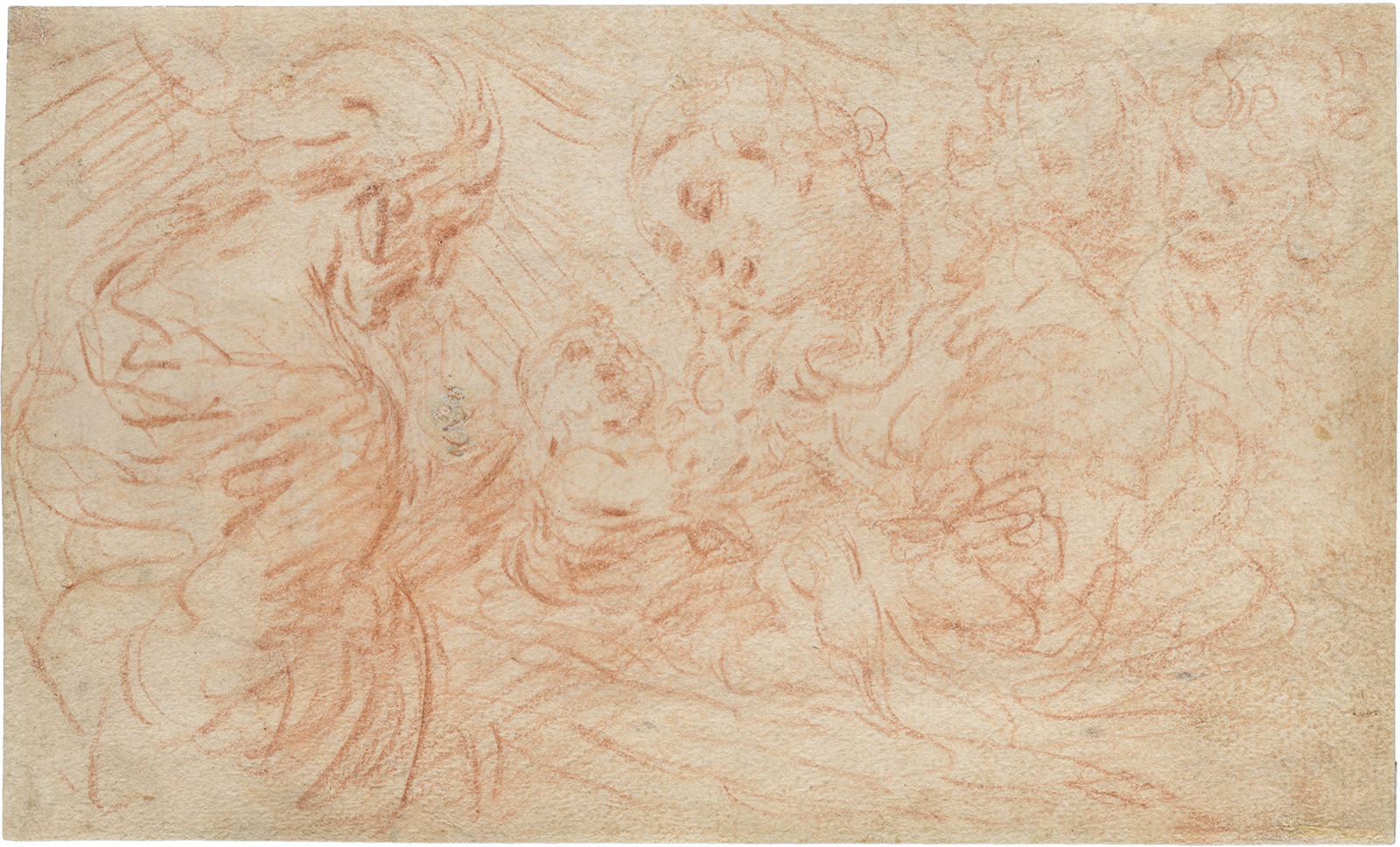
Ercole Procaccini
(Milano, 1605 - Milano, 1677/1680)
Study for an Adoration of the Child, 1650-1660
Red chalk on paper
124 x 205 mm (4.88 x 8.07 inches)
Ercole Procaccini
(Milano, 1605 - Milano, 1677/1680)
Study for an Adoration of the Child, 1650-1660
Red chalk on paper
124 x 205 mm (4.88 x 8.07 inches)
Re: 0288
Provenance
Private collection
Hitherto unknown to scholarship, the image depicts an intimate and animated group of figures, in all likelihood a study for an Adoration of the Christ Child with Saint Anne and the Virgin Mary. On the left stands out the profile of an elderly woman in a turban, caught in an attitude of devout contemplation, her hands stretched out towards the centre of the composition. This is occupied by an infant, very rapidly sketched and held in the arms of a young woman. She tenderly bows her head towards the newborn, following the enveloping movement that pervades the entire scene. The scene unfolds under the protection of two figures of ephebic features in the background, evidently two angels.
In stylistic terms, the sheet displays the unmistakable features of one of the most prolific draughtsmen of the Lombard scene in the second half of the seventeenth century, Ercole Procaccini the Younger. His intense activity, which in truth is still little studied, finds a possible first trace in the account of Carlo Cesare Malvasia. In 1667 Malvasia visited the painter’s Milanese workshop to gather biographical material on the Procaccini dynasty, founded by the Bolognese Ercole the Elder, material he would later include in his Felsina pittrice of 1678.¹ On that occasion the historian recorded the vitality of the ‘accademia del nudo’ [life-drawing academy] run by Ercole the Younger himself. Its rigorous teaching practice seems to be reflected in the artist’s substantial corpus of drawings and, more specifically, in his studies of the nude.² Since the present sheet does not belong to that category, however, one must go back to the early teaching of his uncle Giulio Cesare. From him Ercole inherited his distinctive ductus, made up of short, rapid strokes of red chalk, in which form is identified and constructed through the accumulation of repeated marks.
Unlike the works left by his more famous uncle, however, Ercole’s drawings do not seek the same vibrant plastic incisiveness. They settle rather into a register of renewed Baroque character. This orientation becomes clearer when read in close continuity with the achievements of the leading figures of that extraordinary Milanese cultural season, such as Francesco Cairo, Carlo Francesco Nuvolone and Giovanni Battista Discepoli, known as lo Zoppo da Lugano, who left the scene around the middle of the century. From this perspective, Ercole seems to have ideally taken up the baton from the protagonists of that season, fully absorbing its climate. He never abandoned, however, a structural and eminently graphic vocation that resisted overtly painterly languor. Leaving aside the separate case of Cairo, too poorly documented as a draughtsman,³ the comparison with the other two masters proves particularly fruitful. Nuvolone mostly settled on an evanescent atmospheric softness, and the Zoppo da Lugano on an almost proto-Impressionist tonalism. Ercole’s line, by contrast, preferred to remain firmly anchored to an essential, if tortuous, linearity. His inventions, though charged with a darting theatrical dynamism and often articulated in emphatic poses and enlarged volumes, never lose a well-defined formal scaffolding. In short, while deeply assimilating the new demands of the Lombard Baroque, his idiom never betrays the solid compositional and graphic structure developed under the aegis of his uncle Giulio Cesare. With this approach, Ercole not only preserved the family legacy but went further, anticipating certain successful solutions of the barocchetto. Thanks partly to the mediation of Antonio Busca, his favourite pupil, appointed professor of painting when the Accademia Ambrosiana reopened in 1668, these solutions would find their full expression in the artists of the following generations, such as Federico Bianchi, Andrea Lanzani and Stefano Maria Legnani, known as il Legnanino.
In iconographic terms, the work should be related to other drawings by Ercole centred on the theme of the Adoration of the Child. Clear stylistic and typological links can be found in particular in several sheets in the Biblioteca Ambrosiana, Milan, and the Gallerie dell’Accademia, Venice. These are the Adoration of the Magi and the Mystic Marriage of Saint Catherine of Alexandria in the Ambrosiana,â´ and the Christ Child Asleep on the Cross and the Martyrdom of Saint Agnesin Venice.âµ In them, moreover, the same orchestration of chiaroscuro and the same type of face framed by a vibrant line reappear. These physiognomies, typical of his repertory, also recur in the Fame with a Putto in the Albertina, Vienna.ⶠThere, the strokes that cursively sketch the putto’s bowed head find their exact counterpart in the foreshortened face of the Child in the present sheet. Perhaps the most telling comparison, however, is offered by a sheet now untraced, depicting a Holy Family with an Angel (fig.), formerly attributed to Camillo Procaccini.â· It shares with our Adoration the tight framing and the close-up enlargement of the devotional episode. These solutions reveal the reuse of models typical of Giulio Cesare Procaccini’s repertory, clearly evoked by the angels behind and by the tender face of the woman gently leaning towards the infant. It is precisely here, in this learned blending of family legacies, rendered with a soft yet lively graphic touch, that the most authentic idiom of Ercole the Younger can be grasped. He was among the most intelligent interpreters of drawing in later seventeenth-century Lombardy.
¹ D’Albo 2016, p. 466; Malvasia a Milano 2017, p. 13.
² Most recently, see J. Ranzani, in Disegni a pietra rossa 2024, pp. 86–97, no. 17.
³ Bora 1983, pp. 197–201. Bora’s proposals were only partly accepted by Frangi 1998, p. 136, n. 53. The latter position is still valid, despite the recent attempt by Fiorentino 2024, pp. 32–36, 92–93, no. 20, to rehabilitate Bora’s view. Of some importance, however, is the publication of a preparatory drawing for a David.
â´ Modena 1959, pp. 114–115; Bora 1977, p. 29, no. 32, pl. 32.
âµ Ruggeri 1982, pp. 141–142, nos 126–128.
ⶠStix 1941, no. 452.
â· Le Claire 1984, no. 3.