

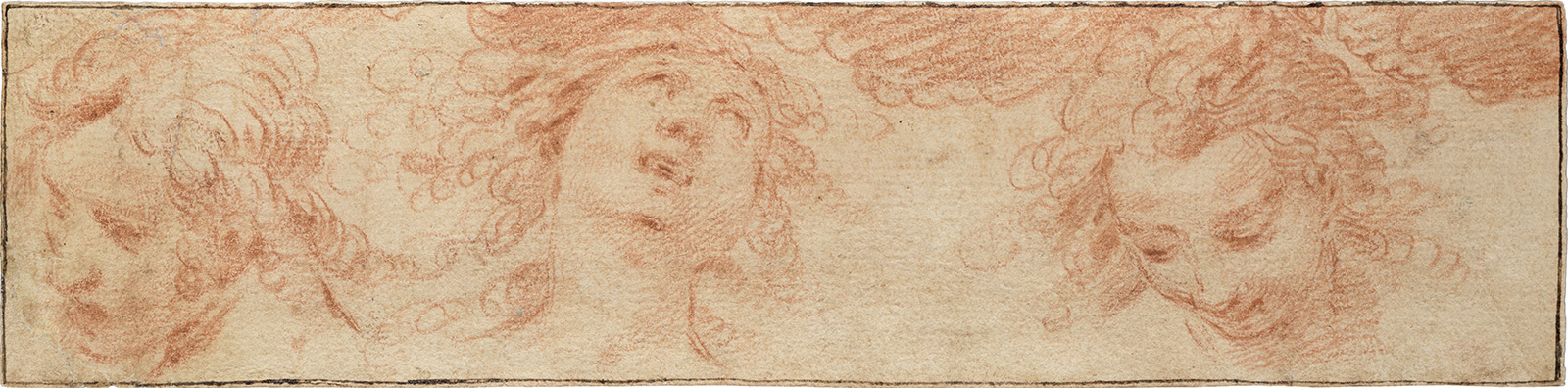
Ercole Procaccini
(Milano, 1605 - Milano, 1677/1680)
Study of Three Female Heads
Red chalk on paper
70 x 283 mm (2.76 x 11.14 inches)
Ercole Procaccini
(Milano, 1605 - Milano, 1677/1680)
Study of Three Female Heads
Red chalk on paper
70 x 283 mm (2.76 x 11.14 inches)
Re: 0289
Provenance
Private collection
The sheet presents a sequence of three female faces which, though isolated in the narrow space of the oblong format, converse through a measured counterpoint of poses and expressions. On the left is a profile bowed downwards. In the centre, a face seen in emphatic di sotto in sù foreshortening, its gaze rapt upwards and its lips parted in an almost ecstatic impulse. Finally, on the right, a girl with gently lowered eyes. The rendering of the features, softened by skilful chiaroscuro transitions and enlivened by vibrant strokes that linger on the curls of the hair, shows a marked sensitivity to expression, allowing the emotional register of each figure to emerge.
In stylistic terms, the work fits naturally into the graphic corpus of Ercole Procaccini the Younger, bringing with it the legacy of his gifted family. The rapid ductus and the accumulation of repeated marks used to define rounded volumes reveal the long wave of the formal models developed by his father Carlo Antonio and, above all, by his uncle Giulio Cesare, his first master. This sheet, however, seems to belong to a much later moment, and can reasonably be placed within the painter’s flourishing teaching activity. Carlo Cesare Malvasia visited the artist’s Milanese workshop in 1667 to gather biographical material on Ercole’s predecessors. As his notes record, Ercole successfully ran a life-drawing academy.¹ During his stay in Milan, the Bolognese historian noted a detail of considerable importance for the present discussion. He recalled that the master, by then ‘tutto canuto’ [completely white-haired], had shown him ‘suoi dissegni di lapis rosso e nero di testine di donne fatte per sua memoria molto ben dissegnate’ [his drawings in red and black chalk of small heads of women, made for his own reference, very well drawn].² The present sheet thus seems to correspond to this successful type of study. It is an academic repertory of attitudes and expressions, conceived both as an exercise for the workshop assistants and as a formal repertory for the master’s own use, ‘per sua memoria’ [for his own reference].
The use of this systematic study of isolated heads is, moreover, well documented in Ercole’s creative process. Close comparisons can be drawn with several red chalk sheets that passed through the art market some twenty years ago.³ They show the same formal vocabulary and the same obsessive interest in bowed heads, whose chiaroscuro Procaccini did not fail to explore through dense, disciplined parallel hatching. It is also interesting to note that these anatomical exercises were not always conceived as independent sheets. In some cases the artist inserted them in the margins of larger and more complex compositions. One example is the Study of Salome in the Nationalmuseum, Stockholm.â´ There the full-length figure of the protagonist is surrounded by a handful of small female heads studied from various angles, drawn with a freshness of execution entirely comparable to that which distinguishes the present drawing.
From this perspective, the sheet is not only a valuable record of the teaching practice within the Procaccini academy. It is also a significant element of a working method that sought to isolate individual physiognomic details and perfect them before their translation onto canvas on a more monumental scale.
¹ D’Albo 2016, p. 466. For an example of an academic nude, see J. Ranzani, in Disegni a pietra rossa 2024, pp. 86–97, no. 17.
² Malvasia a Milano 2017, p. 13.
³ New York, Christie’s, 28 January 1999, lot 69 (red chalk on pink prepared paper, 210 × 280 mm); Paris, Christie’s, 23 March 2006, lot 216 (red chalk on pink prepared paper, 242 × 171 mm).
â´ Bjurström, Loisel, Pilliod 2002, no. 284.