

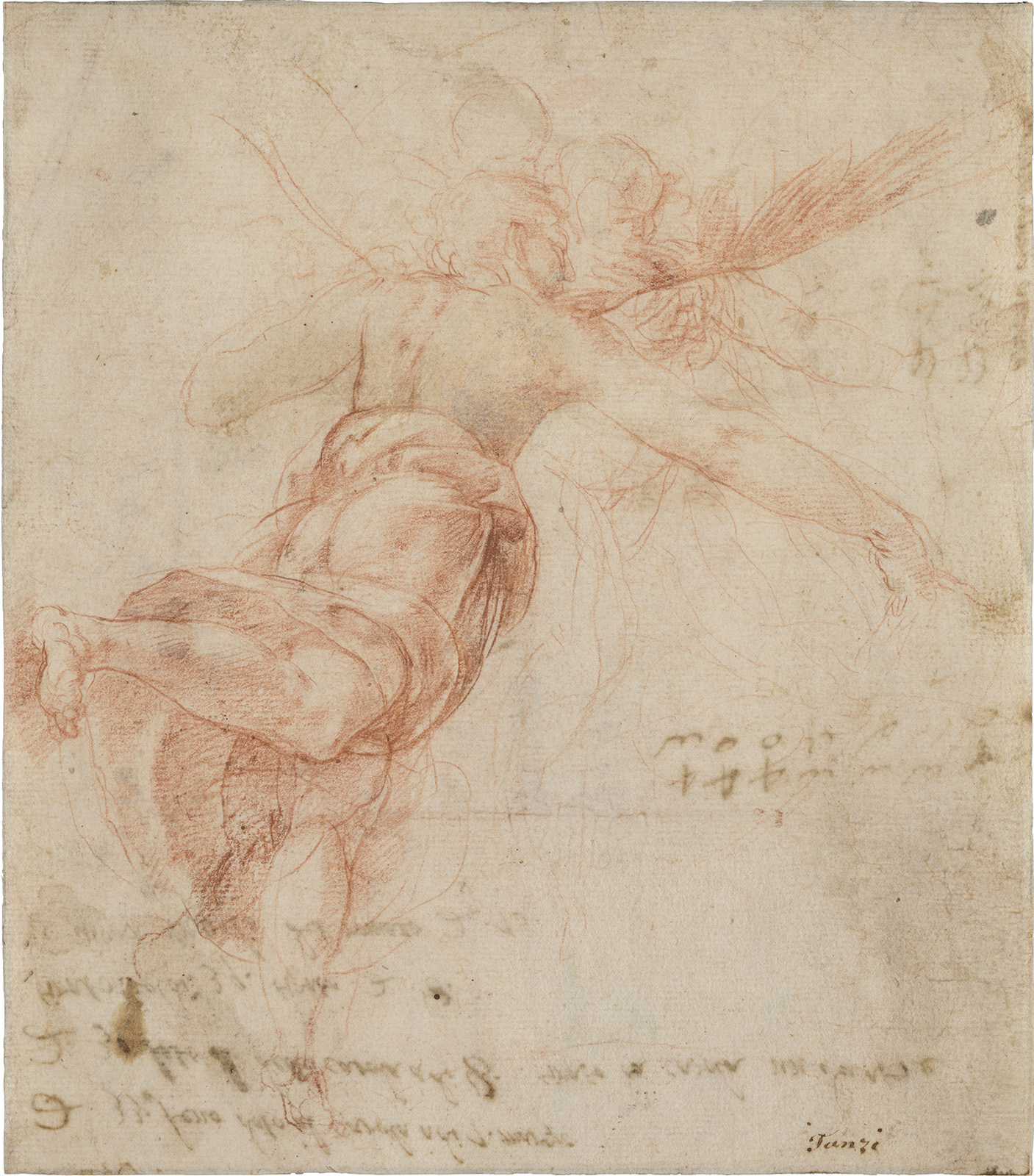
Antonio d'Enrico called Tanzio da Varallo
(Alagna Valsesia, 1580 c. - Varallo, 1633)
Study of an Angel in Flight
Red chalk on paper
216 x 190 mm (8.50 x 7.48 inches)
Antonio d'Enrico called Tanzio da Varallo
(Alagna Valsesia, 1580 c. - Varallo, 1633)
Study of an Angel in Flight
Red chalk on paper
216 x 190 mm (8.50 x 7.48 inches)
Re: 0290
Inscription
«Tanzi», pen, in below, right
Provenance
Boccioleto (Vercelli), Carlo Bartolomeo Borsetti (?);
Milan, Finarte, 21-22 april 1975, lotto 106
Milan, Stanza del Borgo, 1984
Novara, private collection, 199
Literature
S. Bareggi, in to Drawing 1984, pp. 52-53
Testori 1995, pp. 120, 130, fig. 22
Ferro 1999, p. 123
S. Baiocco, in Tanzio da Varallo 2000, p. 189, n. 65; Ferro 2003, pp. 171-172, n. 67 Bareggi, Ferro 2013, pp. 35, 41, nota 46
Vibrant and of strong plastic impact, the sheet presents a dynamic study for a group of angelic figures. Executed in red chalk, the drawing sharply defines the contours of the principal figure. This is a foreshortened angel seen from behind, whose limbs twist through space in a complex torsion, echoed by the vigorous spread of the wings. The sheet first appeared on the Milanese market at Finarte in 1975 and was exhibited at La Stanza del Borgo in 1984. Already correctly discussed as a work by Tanzio da Varallo by Silvana Bareggi,¹ it received definitive confirmation in the studies of Edoardo Testori.² It was Testori, in a fundamental article published in Master Drawings in 1995, who identified the purpose of the work and placed it in the final phase of the painter’s career, immediately winning the agreement of other scholars.³
The sheet is in fact the preparatory idea for one of the Angels in Glory frescoed in a compartment of the presbytery vault in the church of Santa Maria della Pace, Milan, a decorative project datable after 1630 (fig.).â´ The analytical attention to the drapery and the skilful handling of shadow closely recall the results achieved by the painter in the slightly earlier Prophets for Novara. The sheet nevertheless has a feature that is quite unusual among the artist’s drawings. Around the central figure, drawn with an extremely light, almost indistinct line, further heavenly beings hover, testing alternative poses. This bears witness to a compositional search still in progress. The essentially exploratory, rather than strictly preparatory, nature of the study is revealed precisely by the gap between this first, quivering draft and the final painted version. The minor but significant changes made in the course of the work are worth noting. In the fresco, the left arm of the powerful heavenly messenger changes position, while his left leg disappears, hidden by the clouds below. Likewise, the putti barely sketched behind him in the drawing are removed from this section. They reappear, studied at full length, in the lower register of the lunette, where they hold up the scroll inscribed ‘Gloria in excelsis Deo’.
Shown at the monographic exhibition held at Palazzo Reale, Milan, in 2000,âµ the drawing is an essential piece for understanding the practice of the mature Tanzio. It supports the view that he used drawing almost exclusively in the service of painting. In strictly morphological terms, the work reveals the artist’s highly personal style. In it, the noble legacy of the central Italian tradition of draughtsmanship, encountered during his stay in Rome at the dawn of the seventeenth century, merges with the raw, dramatically earthly pictorial conventions typical of Lombard naturalism in the age of the Borromeo. As noted above, the spatial arrangement and the vigour of the line closely recall the studies made in the 1620s for the great fresco cycles. Here, however, the handling shows a subtle change, revealed by a slightly slower and less nervous ductus. This natural decline in linear tension does not, however, detract from the superb command of chiaroscuro of a master able to model volumes on paper with the same feverish urgency as sculptural matter.
Finally, the material history of the work is enriched by valuable historical layers. On the verso there are accounting notes, added later over the artistic invention. On the recto, at the lower right, there is an eighteenth-century inscription in pen reading ‘Tanzi’. This inscription attests to the early critical fortune of the sheet. It was written by the same hand that inscribed ‘originale del Tanzi’ [original by Tanzi] on the study for the Saint Mark now in Copenhagen, published by Pierre Rosenberg in 1966.ⶠFollowing the suggestion made by Giovanni Testori,â· it seems highly plausible to recognise in this handwriting the hand of the Valsesian painter Carlo Bartolomeo Borsetti (1698–c. 1759), who was probably also the author of the accounting notes. This is far from a trivial clue. On the contrary, it would confirm the uninterrupted, first-hand fortune that Tanzio’s inventions enjoyed among artists active in the Valsesia, both his contemporaries and those of later generations.
Fig. Antonio d’Enrico, known as Tanzio da Varallo, Angels in Glory, c. 1630–1633. Milan, Santa Maria della Pace
¹ Disegnare. Un’arte stupefacente. Fogli dal XVI al XIX secolo, exh. cat. (Milan, La Stanza del Borgo, 1984), ed. by S. Bareggi, Milan 1984, pp. 52–53.
² E. Testori, New Drawings by Tanzio da Varallo, in «Master Drawings», XXXIII, 2, 1995, pp. 120, 130, fig. 22.
³ F.M. Ferro, Tanzio da Varallo: catalogo critico dei dipinti, in «de Valle Sicida», X, 1, 1999, p. 123; F.M. Ferro, L’officina grafica di Tanzio da Varallo, in «de Valle Sicida», XIV, 1, 2003, pp. 171–172, no. 67; S. Bareggi and F.M. Ferro, Alcuni disegni inediti di Tanzio da Varallo, in «Paragone», 112, 2013, pp. 35, 41, n. 46, where, however, the provenance given is that of the other Tanzio sheet catalogued here.
â´ For a recent assessment of the frescoes in Santa Maria della Pace, see M.C. Terzaghi, in Tanzio da Varallo. Realismo fervore e contemplazione in un pittore del Seicento, exh. cat. (Milan, Palazzo Reale, 13 April – 16 July 2000), ed. by M. Bona Castellotti, Milan 2000, pp. 144–148.
âµ S. Baiocco, in Tanzio da Varallo, cit., 2000, p. 189, no. 65.
ⶠP. Rosenberg, Un dessin de Tanzio de Varallo au Musée de Copenhague, in «Paragone», XVII, 199, 1966, pp. 54–55.
â· G. Testori, Una postilla e un inedito, in «Paragone», XVII, 199, 1966, pp. 55–56.