

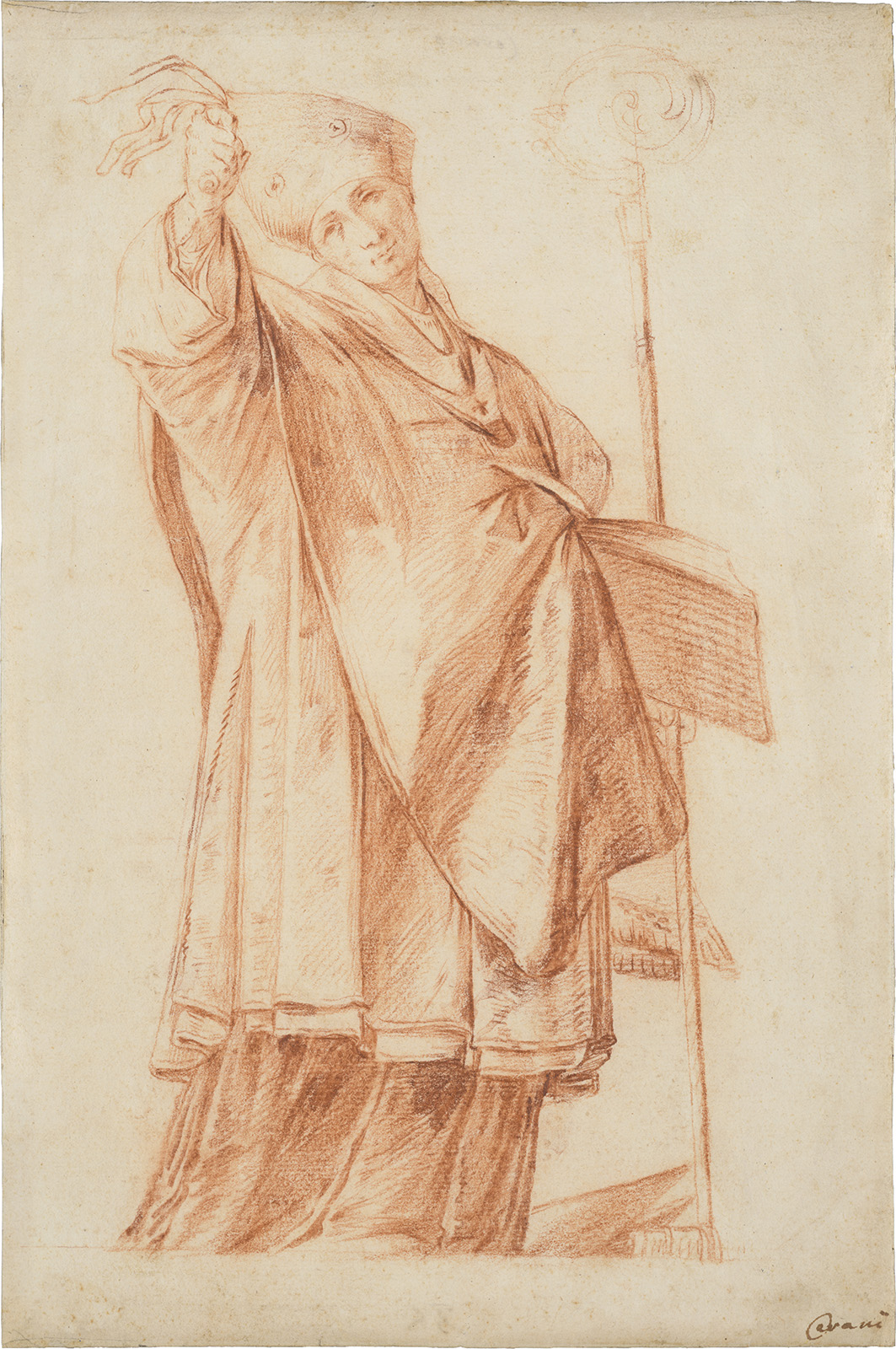
Giovanni Andrea Bianchi, il Vespino
(documento in Lombardia e in Ticino, 1605 - 1626)
Saint Ambrogio, 1620-1630
Red chalk on paper
294 x 396 mm (11.57 x 15.59 inches)
Giovanni Andrea Bianchi, il Vespino
(documento in Lombardia e in Ticino, 1605 - 1626)
Saint Ambrogio, 1620-1630
Red chalk on paper
294 x 396 mm (11.57 x 15.59 inches)
Re: 0292
Inscription
«Cerani», pen, in below, right; «Cerano», a pen, in top, in the center, on the reverse side;
«85», pen, below in the center on the reverse side
Provenance
Private collection
Of considerable interest for reconstructing the practices of study and copying in Borromean Milan, the sheet, apparently unpublished, depicts a powerful Saint Ambrose in episcopal robes, caught in the act of symbolically brandishing the scourge of the true faith against the heresies. The collector’s inscription ‘Cerani’, written in pen at the lower right, immediately reveals that the invention derives from the celebrated canvas by Giovanni Battista Crespi, known precisely as il Cerano, painted in 1610 for the canonisation of Charles Borromeo.¹ Originally part of the ephemeral decorations mounted on the temporary façade of Saint Peter’s in Rome, the work was later given to the Ambrosiana by Cardinal Federico Borromeo in 1618, together with the founding group of paintings of the Pinacoteca.² Although the reference to the Novarese master is unequivocal in iconographic terms, the sheet must be excluded from Cerano’s catalogue. Its ductus is too composed and lacks the expressive urgency that animates Crespi’s drawings.³
Once the reproductive nature of the present sheet is established, any attempt to identify its author requires a wider look at the fortune that Cerano’s painting enjoyed on its return to Milan, where it immediately became a model for several painted derivations. Alongside a version of more modest quality now in the collections of the hospital at Garbagnate Milanese, a far more successful version stands out in the Quadreria Arcivescovile, Milan. It formerly belonged to the collection of Cardinal Cesare Monti, where it is documented as early as 1638 (fig.).â´ Compared with the overwhelming monumentality of Cerano’s prototype, the Archbishop’s version is distinguished by a stereotyped pathos. This is further accentuated by the vigorous chiaroscuro that furrows the flesh of the face, emphasising its features, marked by narrow eyes and tightly pressed lips. On close inspection, all these qualities seem to evoke the repertory of types deployed by a master held in the highest esteem in the artistic climate of the Ambrosiana’s early years: Giovanni Andrea Bianchi, known as il Vespino.
Documented in Lombardy and Ticino in the first three decades of the seventeenth century, Vespino was indeed one of the most skilled and renowned copyists in the service of Cardinal Borromeo, from 1605–1606 until at least 1621.âµ He made careful copies after Leonardo da Vinci, Bernardino Luini and Parmigianino for the school of painting founded at the Ambrosiana in 1620. He was also a professor at the same institution, and was indeed involved in the first attempts at teaching as early as 1613.ⶠAs noted above, stylistic analysis seems to support this attribution. The physiognomy of the Archbishop’s Saint Ambrose closely recalls the features of some of the Apostles, for example Thaddeus, in the copy of Leonardo’s Last Supper still in the Pinacoteca Ambrosiana, on which Vespino worked between 1611 and 1616.â·
At the same time, the austere composition and the explicit reference to Cerano echo solutions similar to those adopted by Bianchi in his independent works. One thinks of the Saint Charles and the Saint Ambrose in the Milanese church of San Bernardino alle Ossa, datable to around 1616,⸠and of the Virgin of the Rosary in the parish church at Brissago. The latter can be dated close to 1619, the year of foundation of the Oratory in the Camposanto, Milan, from which the altarpiece comes.â¹ Conversely, the dense, golden light that breaks up and crumples the drapery already seems to point towards the high point of Vespino’s small catalogue. This is the Saint Charles in Glory in Santo Stefano in Brolo, Milan, a work of clear Morazzonesque inspiration. It was formerly dated to 1637,¹â° but should be moved back at least to the end of the previous decade, since the master died before 9 February 1630.¹¹
Beyond the stylistic evidence, and thus the painter’s evident inclination towards Cerano’s approach, the attribution is further supported by Vespino’s long-standing practice of copying, carried out with a very high degree of fidelity to the original models. This should be considered together with his permanent presence in the milieu of the Ambrosiana. There he would have had direct access to Crespi’s original, which arrived in 1618, and could thus study it closely in preparation for the canvas now in the [Quadreria Arcivescovile].
If this reconstruction is accepted, it is more than plausible that the artist made use of a preparatory drawing to mediate this refined process of copying. Given its marked closeness to the former Monti canvas, it is tempting to recognise such a drawing in the present sheet. It shares the same physiognomic inflections and formal structure as the Archbishop’s painting, and to all intents and purposes appears to be a preliminary study for a subsequent painted version. Given the acknowledged slenderness of Vespino’s catalogue, however, the attribution of the drawing proposed here must necessarily remain a suggestive working hypothesis, to be accepted with due caution. There is, moreover, at present no known corpus of his drawings that could provide points of comparison.
Fig. Giovanni Andrea Bianchi, known as il Vespino (attr.), Saint Ambrose, c. 1620–1630. Milan, Quadreria Arcivescovile
¹ [Tela Cerano.]
² Terzaghi 2005, pp. 150–155.
³ Bora 2005, pp. 213–223; Neilson 2005, pp. 225–229, with the related entries on pp. 230–279, nos 58–91.
â´ S.A. Colombo, in Le stanze del Cardinale 1994, p. 263, no. 33.
âµ Barbieri 2019, pp. 149–160.
ⶠOttino Della Chiesa 1968, s.v.
â· M. Rossi, in Pinacoteca Ambrosiana 2006, pp. 271–273, no. 328.
⸠M. Gregori, in Il Morazzone 1962, pp. 122–123, nos 108–109, pl. 242. The altarpiece in San Bartolomeo at Groppello d’Adda, dated 1617 and discussed by Barbieri 2019, pp. 156–158, fig. 1, should instead be a collaborative work.
â¹ L. Damiani Cabrini, in Pittura a Como 1994, pp. 318–319, pl. 107. Also connected with this work is the Crucified Christ with a Franciscan Friar in the Quadreria Arcivescovile, Milan, published by F. Frangi, in Le stanze del Cardinale 1994, p. 200, no. 70.
¹â° M. Gregori, in Il Morazzone 1962, p. 122.
¹¹ Squizzato 2013, pp. 184–185: the payment for ‘tre quadri di ritratti di Casa Trivulzia cardinali’ [three paintings of portraits of the Trivulzio cardinals] was received not by ‘Gio. Andrea Bianco detto Vespino’, as in other entries in the ledger, but by the ‘eredi del Vespino’ [Vespino’s heirs].