

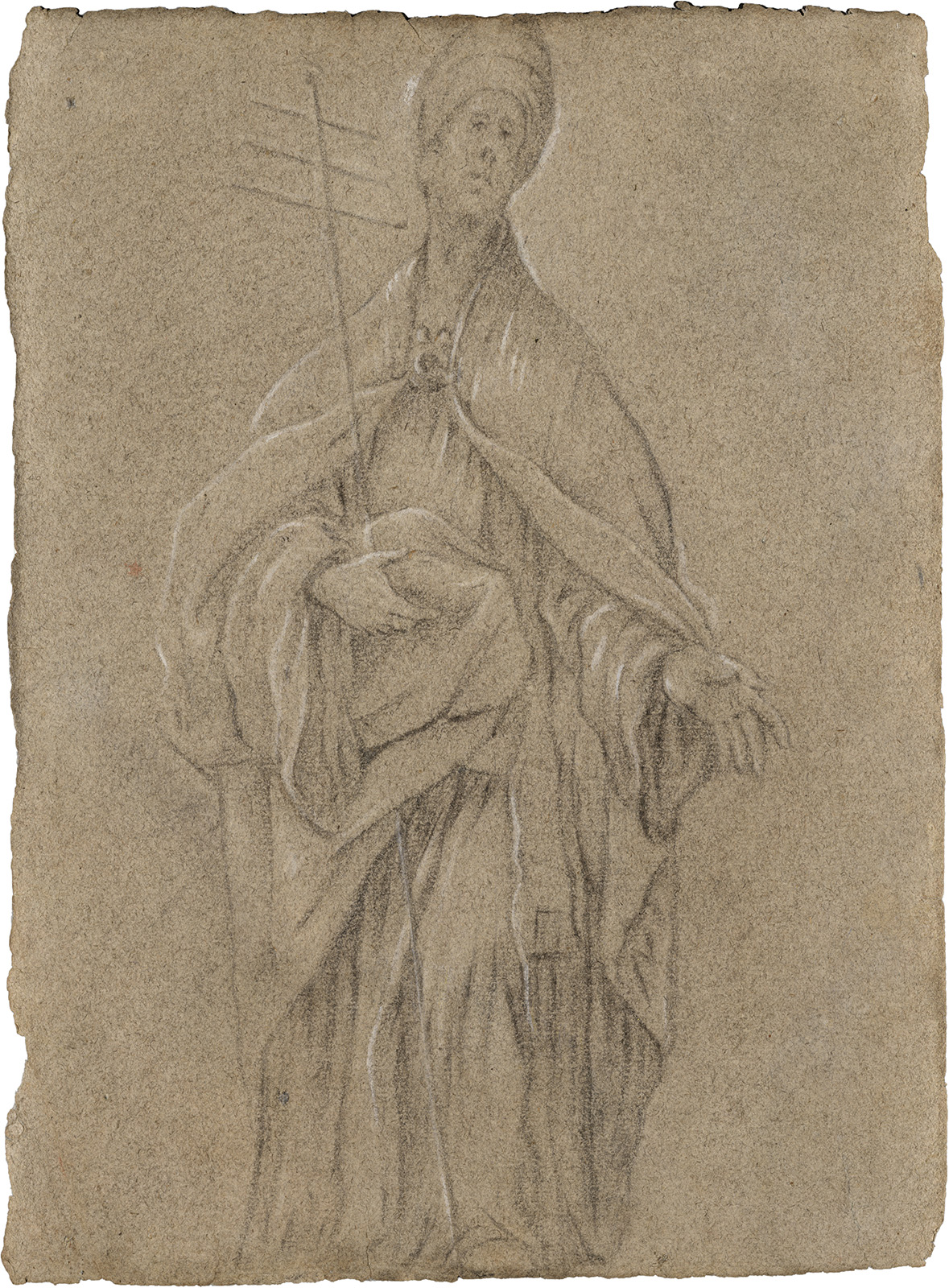
Giovanni Battista Discepoli
(Castagnola (Lugano), 1590 - 1654)
Study for Saint Pope, 1645-1650
Black chalk, on paper
266 x 196 mm (10.47 x 7.72 inches)
Giovanni Battista Discepoli
(Castagnola (Lugano), 1590 - 1654)
Study for Saint Pope, 1645-1650
Black chalk, on paper
266 x 196 mm (10.47 x 7.72 inches)
Re: 0293
Provenance:
Private collection
Hitherto unpublished, the drawing depicts a monumental male figure in an attitude of intercession. He is wrapped in a voluminous liturgical mantle, fastened at the chest by a morse, whose broad folds lend solemnity to the modelling. His head is crowned by a tall, conical headdress with superimposed tiers, recognisable as the papal tiara, while his right arm holds a triple-barred papal cross firmly against his chest. These elements, together with the intention of evoking the radiance of a halo by means of lead white, allow the subject to be identified as a sainted pope, of the type of Saint Gregory the Great or Saint Sylvester. At present, however, given the entirely conventional nature of these attributes and the absence of more specific symbols, it is not possible to determine the figure’s identity more precisely.
Having re-emerged from a private collection, where it was kept with a telling attribution to Francesco Cairo, the sheet belongs instead in the graphic corpus of another undisputed protagonist of the Lombard scene in the mid-seventeenth century. I refer to Giovanni Battista Discepoli, known as lo Zoppo da Lugano, an accomplished draughtsman as well as an acknowledged painter. The fluency of the line and the vibrant tension of the chiaroscuro point first and foremost to him.¹ The handling of the charcoal, which models the plasticity of the drapery with assured grandiloquence, is fully consistent with the drawings made by the Ticinese master between the late 1640s and the early 1650s. By then, the influence previously exerted by the works of Cerano and the Fiammenghini had given way to a greater inclination towards tonal values, revealed by a more explicitly painterly treatment of chiaroscuro. It is precisely this renewed stylistic inclination that attests to Discepoli’s adoption of a more overtly Baroque idiom. It enabled him to keep pace with the more festive and up-to-date solutions spread in the middle of the century by the new champions of painting in Milan, Francesco Cairo and Carlo Francesco Nuvolone.
In this spirit, the artist exploited the underlying tone of the paper to enliven the broad folds of the cope with soft, evanescent lead-white highlights. He reveals a sensibility entirely akin to that found in the Study of a Boy in the Biblioteca Ambrosiana, Milan. That sheet, not by chance, was discussed first as a work from Cerano’s circle,² then as an autograph work by Cairo.³ A further comparison is offered by the Saint Michael the Archangel Casting Down the Rebel Angels in a private collection. Despite its incipient compositional exuberance, it shares with the present sheet the same concise definition of the features, reduced in effect to dots and lines.â´ Not to mention the refined Female Figure Playing the Violin, also in a private collection.âµ This sheet was executed in the same technique as the present drawing, and on its verso bears a Study of an Arm. Its hand is articulated with the same scrupulous anatomical clarity that distinguishes the gesture of our pope.
The very type of subject is also entirely in keeping with the Zoppo da Lugano. Centred on a solemnly robed cleric, it closely recalls the rich repertory of bishop saints and monks that the master drew in the so-called album of Santa Maria presso San Celso, now in the Archive of the Archdiocese of Milan.ⶠThis formidable collection is today an indispensable tool for following the development of the painter’s graphic idiom. It moves from the rigorous pathos of Borromean culture in the early 1640s to the openly painterly, proto-Impressionist line of his very late maturity. Placed within this precise chronological range, the drawing reveals its perfect formal balance. On the one hand, it betrays his firm adherence to the new Baroque demands of the Milanese school. On the other, it stops short of the bolder, twilight dissolutions typical of the Ticinese artist’s very last years of activity. This evidence requires the present sheet to be placed at the centre of this trajectory, narrowing its date to around 1650.
¹ Bernardini 2001, pp. 65–72.
² Rosci 2000, p. 204.
³ Fiorentino 2024, pp. 35–36, fig. 10.
â´ Jona 1988, pp. 9–10; Bernardini 2024, pp. 70–71, fig. 41.
âµ A. Bernardini, in Giovan Battista Discepoli 2001, p. 161, nos 43–44.
ⶠIbid., pp. 162–167, nos 45–53.