

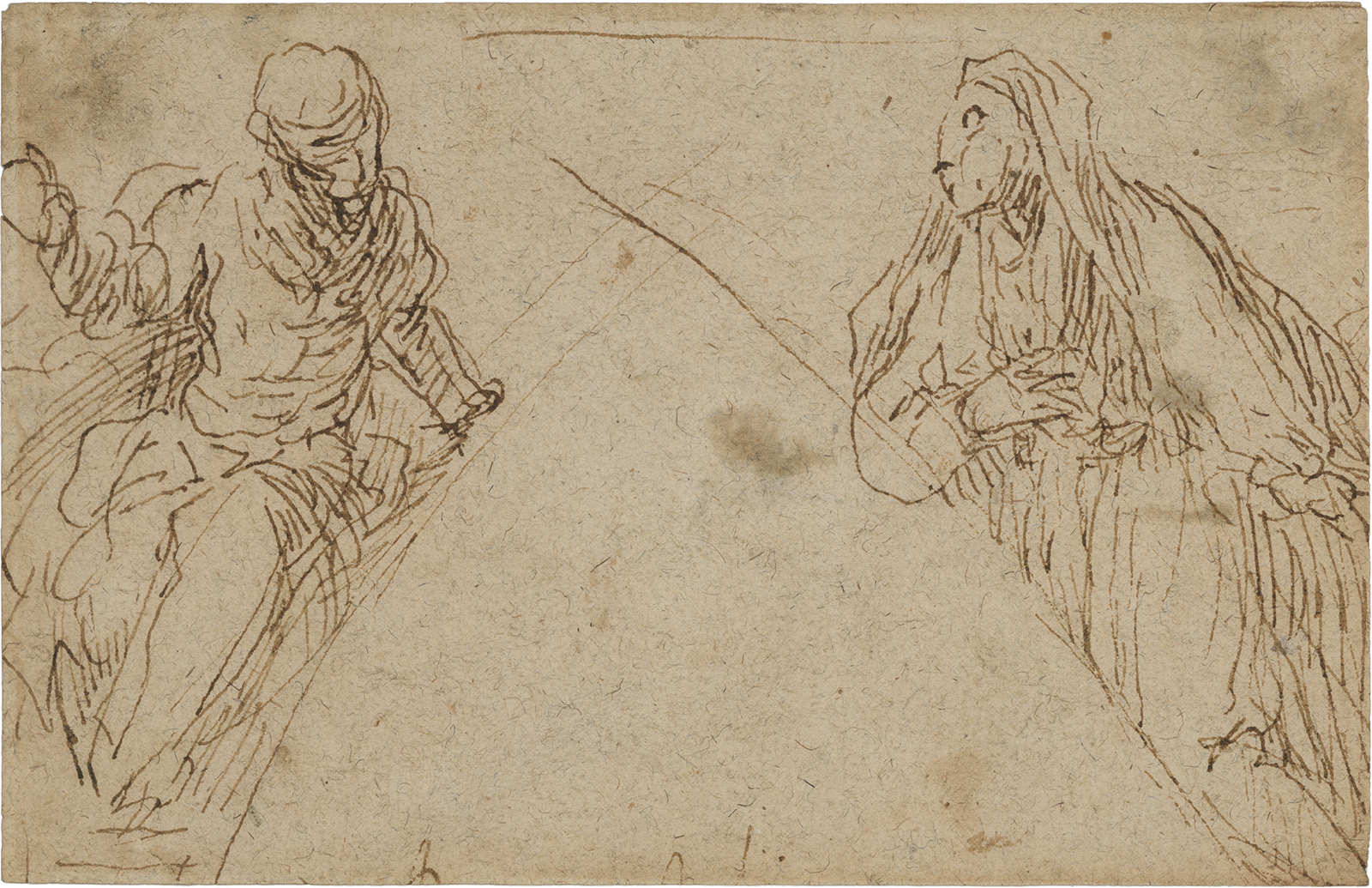
Francesco Curia
(Neaples, 1538 - Neaples, 1608)
Pen and brown ink on white paper
103 x 160 mm (4.06 x 6.30 inches)
Francesco Curia
(Neaples, 1538 - Neaples, 1608)
Pen and brown ink on white paper
103 x 160 mm (4.06 x 6.30 inches)
Re: 0295
Provenance
Private collection
Inscription
traces of a cut inscription
The image is a rapid pen sketch of two figures set within triangular spaces, which can be identified as two architectural [spandrels / pendentives]. At first glance they might appear to be a prophet and a sibyl. Close analysis of the gestures, however, suggests a different reading. The figure on the right devoutly raises her hand to her breast, in the unmistakable pose of the Virgin Annunciate in dialogue with the Angel of the Annunciation, shown in the left-hand section. Along the lower edge are the remains of a trimmed inscription, which unfortunately cannot be reconstructed.
The drawing, unpublished, has re-emerged from a private collection with no particular information on its earlier provenance, bearing only an untenable attribution to the school of Palma il Giovane. Once the Venetian attribution is set aside, the distinctive features of the ductus point unhesitatingly to the Neapolitan painter Francesco Curia.¹ Our understanding of the painter’s graphic activity rests largely on the fundamental group of sheets assembled at the end of the seventeenth century by Nicodemus Tessin the Younger, now in the Nationalmuseum, Stockholm. In the present sheet the pen line is rough, cursive and markedly abbreviated. It reveals a close dependence on the models of the great Roman Maniera, and in particular on the work of Polidoro Caldara, better known as Polidoro da Caravaggio. The aesthetic of Polidoro was indeed an inescapable point of reference for Curia, whose use of an impetuous graphic vocabulary has at times led to confusion between the two masters.
These stylistic features find striking parallels in several of the artist’s works. The broken line and the construction of chiaroscuro contrasts through a dense grid of cross-hatching closely recall the handling of the sketch of the Three Marysin the Museo di Capodimonte, Naples.² Equally close affinities can be found in the Tessin collection, notably in the Female Saint with a Putto, the Entombment of Christ, the Bishop Saint with Two Angels, the Annunciation and the Adoration of the Shepherds. All these Stockholm sheets share the same cursive and structural swiftness.³ Further parallels can be drawn with the Virgin in the Biagio De Giovanni collection, Naples,â´ with the Annunciation and the Woman Supplicant in the Metropolitan Museum of Art, New York, and with the sketch of a Female Figure with Drapery and Two Heads in the Courtauld Institute, London, long believed to be by Polidoro himself. Like the works cited above, this sheet shares with our composition the same expressive urgency and the same vibrant, calligraphic line.âµ
Establishing a rigorous chronology for Curia’s drawings is difficult. Even so, the features of the handling point to the artist’s late activity. Compared with his early works, marked by a more graceful and pointed line, the stroke here becomes fuller and more summary. This modus operandi is consistent with that seen in the Capodimonte and De Giovanni sheets mentioned above. In those drawings, structural synthesis not only marks the artist’s full maturity but already openly anticipates the new pathos and naturalism of seventeenth-century Neapolitan draughtsmanship. These achievements are also well exemplified by the Study of Angels in a private collection in New York. That sheet already looks ahead to the plastic results that would distinguish the Glory of the Virgin painted around 1602–1603 on the ceiling of the church of Santa Maria la Nova, Naples.â
¹ For Curia’s drawings, see Leone de Castris 1984, pp. 11–24; Causa Picone 1999, pp. 79–86; Di Majo 2000, pp. 182–194; Di Majo 2002, pp. 17–20, 137–179; Di Majo 2005, pp. 157–164.
² Di Majo 2002, p. 140, no. D5.
³ Ibid., pp. 152–154, 156–157, 160, 166, nos D25, D29, D36, D47, D66.
â´ Causa Picone 1999, pp. 83, 85, fig. 10.
âµ Di Majo 2002, pp. 148, 175–176, nos D19, D90, D92.
ⶠIbid., p. 178, no. [D]99.