

Giovanni di Niccolo' Bellini
(Venice, early XV – Ferrara 1460)
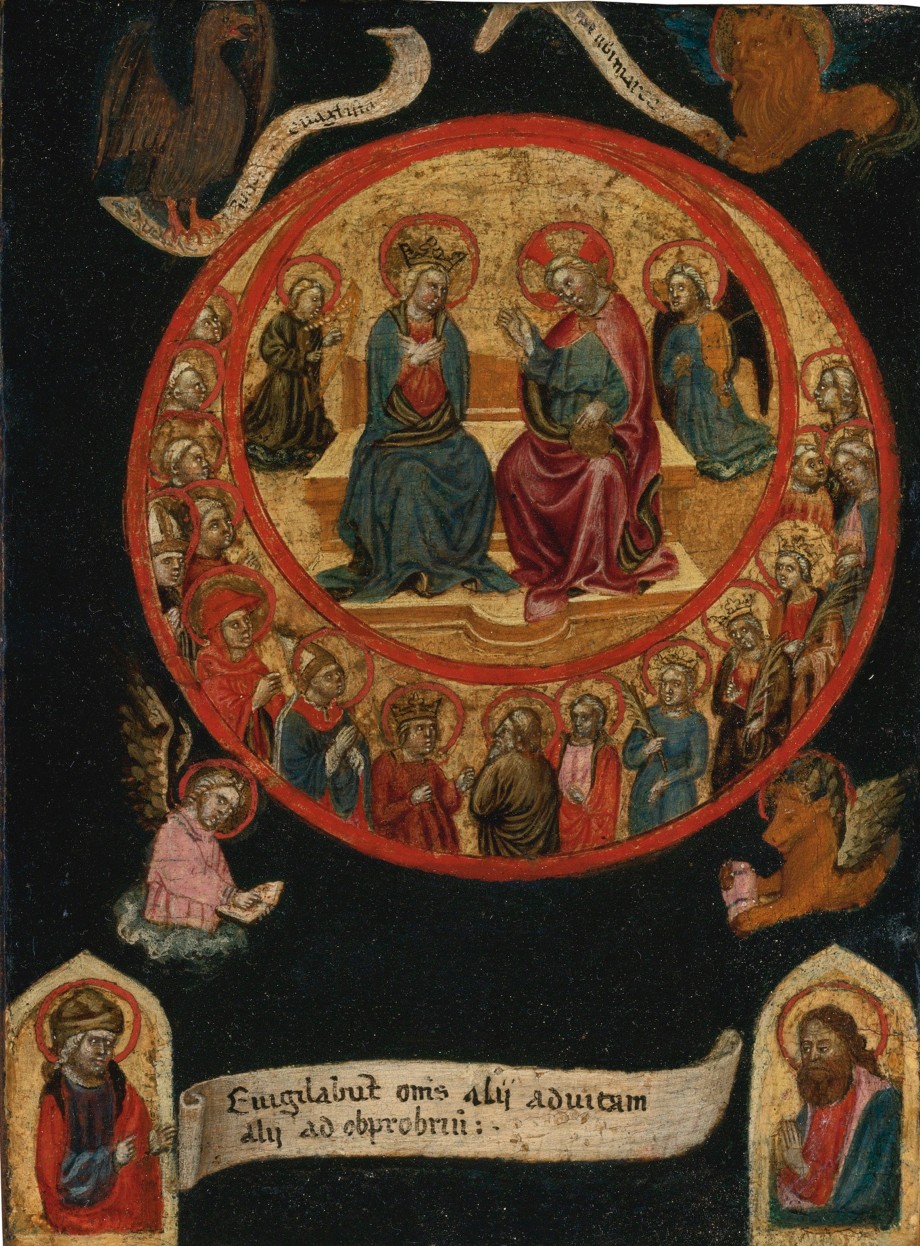
Christ and the Virgin in Glory, c.1420
tempera on panel, 23 x 17,3 cm (9.06 x 6.81 inches)
Giovanni di Niccolo' Bellini
(Venice, early XV – Ferrara 1460)
Christ and the Virgin in Glory, c.1420
tempera on panel, 23 x 17,3 cm (9.06 x 6.81 inches)
Re: 894
Provenance
Private collection
Literature
C. Guerzi, Una “Biblia Pauperum di Giovanni di Niccolò Bellini (già Maestro dell’Avicenna) in “Rivista d’Arte” 2014, pp. 39 – 40; A. Tempestini, La famiglia dei pittori Bellini. Precisazioni e Novità, in “Artibus et Historiae” 2019, p. 27
Giovanni di Niccolò Bellini, Jacopo's brother and therefore Giovanni and Gentile's uncle, is the oldest and, to date, least known member of a family that had a fundamental influence on the artistic life of Venice for a century. The reconstruction of his activity is a fairly recent undertaking and started from the correct reading of the signature that appears in the Coronation of the Virgin in the Pinacoteca Nazionale in Ferrara, a city where Giovanni di Niccolò probably worked for a long time and where he died in 1460.
Scholars, in particular Andrea De Marchi, Chiara Guerzi and Anchise Tempestini, have been able to attribute an interesting body of paintings and miniatures to the Venetian painter, previously attributed to artists without a known identity such as the Master of Ceneda and the Master of Avicenna.
In the centre of our panel, in a golden sphere, Christ and the Virgin are enthroned with two musician angels at their sides. In a more external circle, according to a rather rare iconography that finds few precedents in the field of miniatures, fifteen saints worship and contemplate the figures of the innermost circle. On the outside are the four symbols of the Evangelists and in the lower part two prophets hold up a scroll with a passage from the book of Daniel. It is thanks to Chiara Guerzi that these paintings have been reunited with four other panels – two in the Kress collection and two that have come onto the market fairly recently – to form the surviving elements of an altar frontal or a large polyptych.
In these works and in the Ferrara panel, Giovanni di Niccolò Bellini shows himself to be a refined painter, attentive to detail – an attention worthy of a miniaturist; his cultural references seem to be the artists active in Venice in the first twenty years of the 15th century, Niccolò di Pietro, Jacobello del Fiore and Cristoforo Cortese. Less present is the influence of Gentile da Fabriano, who instead played an important role in the training of his brother Jacopo. One would think that a few years separated the two brothers and that Giovanni was already a trained artist active in the second decade of the 15th century, a date that probably fits well with the complex of which the present tablet was a part.