

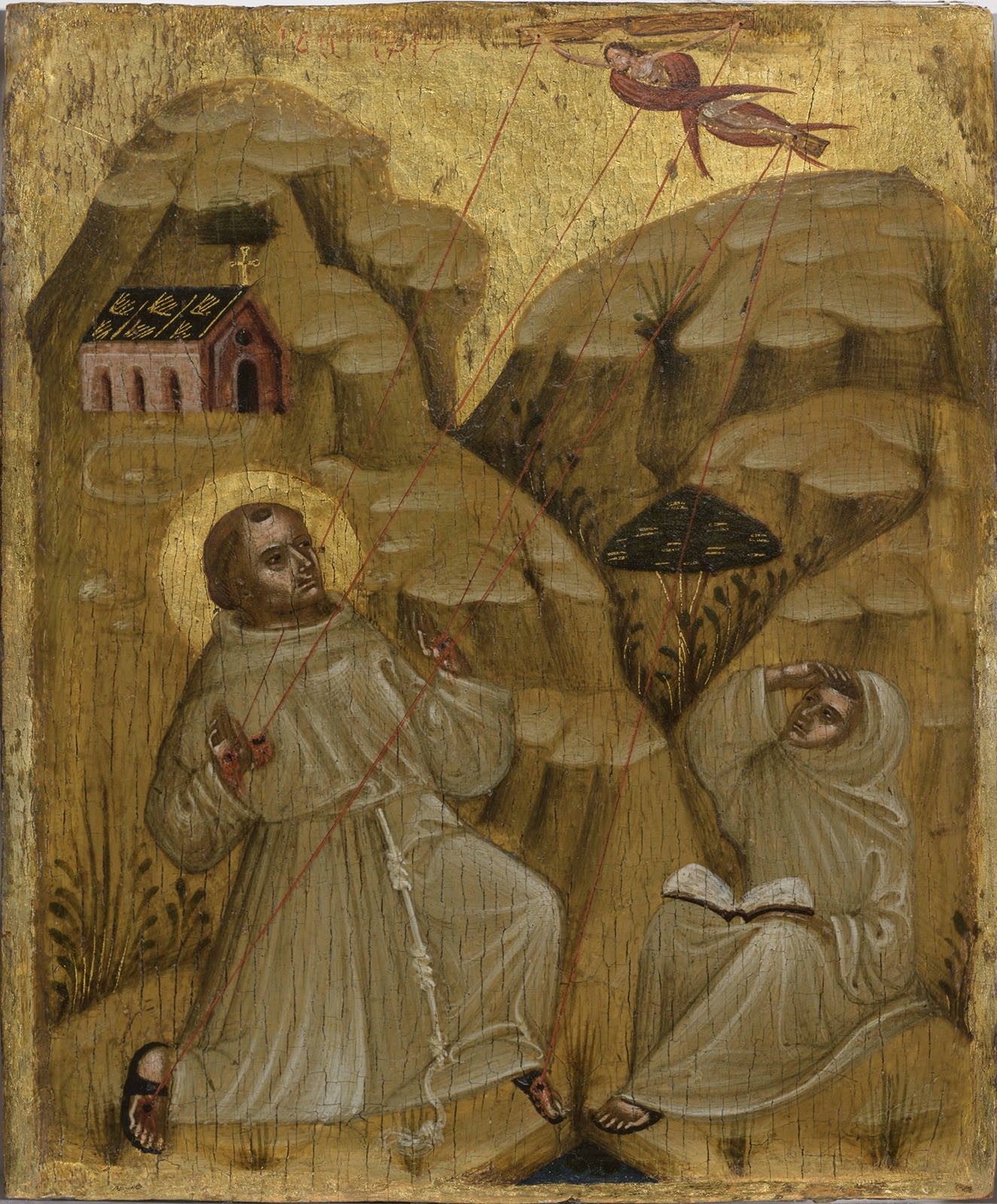
Jacobello del Fiore
(Venice, c.1375 - 1439 Venice)
St. Francis Receiving the Stigmata, 1395-1400
tempera on panel, gold ground, 16,5 x 13 cm (6.50 x 5.12 inches)
Jacobello del Fiore
(Venice, c.1375 - 1439 Venice)
St. Francis Receiving the Stigmata, 1395-1400
tempera on panel, gold ground, 16,5 x 13 cm (6.50 x 5.12 inches)
Re: 895
PROVENANCE
Parcieux (Lyon), Albin Chalandon (1809-1885)
Private collection
EXHIBITIONS
C. Acidini - A. Tartuferi, San Francesco e la terra di Arezzo, Fondazione Guido d’Arezzo, Arezzo, 3 ottobre - 31 dicembre 2026 (forthcoming)
This small painting depicting St. Francis Receiving the Stigmata which has come down to us in excellent condition, formerly belonged to the Chalandon collection, one of the most prestigious private collections in France, begun by Albin Chalandon (Lyon, 1809 – Parcieux, 1885) who fell in love with the Italian Primitives while serving as an officer in the Sappers Corps in Bastia, Corsica, in 1837. His collection grew as a result of purchases made both in the course of frequent visits to Italy and at the sale of other collections, but on his death it was gradually dispersed by his three children and various grandchildren (although some of these made further purchases). Federico Zeri, who knew the collection well, studied the paintings hanging in the Château de Grange Blanche in Parcieux, near Lyon, in the mid-1950s, as we can see from the photographs is his Photographic Library (1).
In the course of recent cleaning, restorers noted that the panel, with its vertical veining, had not been sawn at any point, which suggests that it was designed as an individual item for private devotion. Although having said that, we cannot rule out the possibility that it may have been part of a diptych, or of one of those small portable polyptychs, possibly with episodes from the life of St. Francis, similar to Simone Martini’s “Orsini Polyptych”(2).
The depiction of the famous miracle reflects the traditional iconography of the figurative lectio of St. Bonaventure (1263–6) as codified by Giotto in Scene XIX in the Legend of St. Francis frescoed in the upper church of San Francesco in Assisi, with the image of Christ as a Seraph appearing to the saint on Mount La Verna on 17 September 1224 against the backdrop of a very rocky landscape, yet captivating for all that (a far cry from the “savage rocks” evoked by Dante in his Paradise, IX, 106) with a wealth of naturalistic detail such as bushes and clumps of grass in the foreground, and rich, luxuriant vegetation growing in the gulley between two rocky crags. Nor did the artist neglect to embellish his account of this crucial moment in St. Francis’s human and spiritual progress with delicate filaments of gold on the plants, on the leafy boughs of the trees in the centre of the scene and even on the sloping roof of the Sanctuary of La Verna, the façade of which is surmounted by a similarly gilded cross. The panel is quite clearly the product of a painter of considerable talen, as we can see both from the solidly plausible sculptural and spatial treatment of the rocky backdrop and from the frank brushwork of St. Francis’s and of Brother Leo’s habits, whose sculptural density is enhanced by truly remarkable draughtsmanship without a hint of hesitation – a fact confirmed by reflectographic examination which revealed a meticulous design completed right down to the smallest detail.
Nor can we fail to appreciate the neo-Giottesque solidity of the figure – especially the head – of St. Francis, a fact that would appear to rule out the attribution to the circle of Lorenzo Veneziano c. 1370 that accompanied the picture, which, to the best of my knowledge, has never yet been the object of a scholarly publication. That the panel is a product of late 14th century Venetian culture is, of course, beyond question; yet by the same token, it is clear that its stylistic features point precisely to the artist’s will to go beyond the dogged adherence to the Byzantine tradition that was such a feature of the work of Lorenzo and the artists close to him throughout their careers. The artist who painted the small panel under discussion here, on the other hand, was looking forward, to the more progressive direction in which Venetian painting was moving – a direction, inspired by developments in Bologna and Padua towards the end of the third quarter of the century, that was to witness the triumph, in the city of Venice, of artists of the calibre of Niccolò di Pietro and of another important figure initially given the name of “Pseudo-Jacopo Avanzi” and subsequently rechristened the “Master of the Giovanelli Madonna”. His now convincing identification as Jacobello del Fiore at the start of his career is the product of exemplary scholarship based on the best and most stringent application of the philological method, starting with the ‘prophetic’ connection made by Roberto Longhi between Triptych no. 14 in the Gallerie dell’Accademia in Venice originally in the church of San Gregorio, and a Madonna and Child ,formerly in Palazzo Giovanelli in Venice, which resurfaced in recent years in the Galleria Di Castro in Rome.
Nor was Luigi Coletti’s proposal that the Venetian triptych be attributed to Jacobello del Fiore’s early career by any means less prophetic! (3). And since then, a number of important essays from, among others, Andrea De Marchi, Mauro Lucco, Ileana Chiappini di Sorio (4) and, above all, Daniele Benati in a monographic work published in 2007 (5), have clarified – naturally, not without differences of opinion and individual reservations over attributions – the crucial role played by Jacobello del Fiore as a driving force for renewal in painting in Venice at the turn of the 14th century and on into the first quarter of the 15th. A more recent examination of the Venetian painter’s career may be found in the doctoral thesis of Valentino Anselmi, presented at Florence University in 2014 (6).
Careful scrutiny of some of the stylistic features in the panel under discussion here allows us, in my view, to add it to the corpus of works that are attributed on a more stable basis to Jacobello’s earliest career. The rapidly flowing brushwork of Brother Leo’s habit for example, stands comparison with the habit worn by St. Francisin the right-hand panel of the triptych in the Gallerie dell’Accademia which, together with the former Matthiesen Crucifixion now in the Toledo Museum of Art in Toledo, Ohio (inv. no. 2008.170), which is the focus of Benati’s essay mentioned above, may well be the earliest work attributable to Jacobello del Fiore. As we can see from a detail this latter panel also displays a wealth of thin, gold filaments on the figures’ clothing and on the architecture, pointing to a similar taste for pleasing decorative effects(7). Even closer comparison can be made between the landscape in the background of our panel with those in two small panels in the Pinacoteca Vaticana, depicting the Agony in the Garden and the Lamentation over the Dead Christ from a series of Stories from the Passion to which the Way to Calvary in the Royal Collections in Hampton Court and a Capture of Christ that recently resurfaced in an auction held by Pandolfini in Florence(8) also belong. A comparison of certain details in the treatment of the rocks and the vegetation in our small painting and in the two Vatican panels reveals a surprising affinity not merely in morphological terms but also in terms of taste.
In view of the above remarks, therefore, the small panel under discussion here can convincingly be listed among Jacobello’s earliest work and was probably painted at the turn of the 14th century, shortly after his presumed departure from the workshop in which he had trained – a workshop run, according to a consolidated Venetian tradition, by his father, Francesco del Fiore. The reconstruction of Francesco’s artistic personality, however, is still vague, now that Andrea De Marchi’s suggestion that he should be identified as the “Master of the Giovanelli Madonna” has been superseded by the now broadly accepted theory put forward by Benati.
(1) For the Chalandon collection and attendant bibliography, see V. Baradel, Rileggendo le ‘Aggiunte a Zanino di Pietro’, in Federico Zeri: lavori in corso, ed. A.Bacchi, D.Benati, A. De Marchi, A.Galli, M. Natale, Bologna 2019, p. 88, note 15.
(2) See the photographic reconstruction in V. M. Schmidt, Painted Piety. Panel Paintings for Personal Devotion in Tuscany, 1250-1400, Florenze 2005, p. 282, figs. 187-188.
(3) R. Longhi, Viatico per cinque secoli di pittura veneziana, Florence 1946, pp. 47-48; now in Opere Complete, vol. X, Ricerche sulla pittura veneta, 1946-1969, Florence 1978, pp. 3-39.
L. Coletti, Pittura veneta del Quattrocento, Novara 1953, p. XI.
(4) A. De Marchi, Per un riesame della pittura tardogotica a Venezia: Niccolò di Pietro e il suo contesto adriatico, in «Bollettino d’arte», 6a Ser., LXXII, 44/45, 1987, pp. 31-33; A. De Marchi, Ritorno a Niccolò di Pietro, in «Nuovi Studi», II, 1997, pp. 11-13, 23 note 83; M. Lucco, Venezia, 1400-1430, in La pittura nel Veneto. Il Quattrocento, ed. M. Lucco, vol. I, Milan 1989, pp.13-48;
(5) D.Benati, Jacobello del Fiore. A Crucifixion and a Reconstruction of His Early Career, Matthiesen Fine Art Ltd., London 2007. For a recent biographical-documentary profile, see C.B. Strehlke, in C.B. Strehlke – M. Brüggen Israëls, The Bernard and Mary Berenson collection of European Paintings at I Tatti, Milan-Florence 2015, pp. 350-351.
(6) V. Anselmi, Jacobello del Fiore o della pittura a Venezia tra il neogiottismo di fine Trecento e la ‘rivoluzione’ gentiliana, PhD in “Storia delle Arti e dello Spettacolo”, Supervisor Prof. Andrea De Marchi, Academic years 2012–14, 2015 (may be downloaded on line).
(7) The Crucifixion now in Toledo (Ohio) was published by Edoardo Arslan as a work by Altichiero, on the strength of undeniable direct citations both of the Crucifixion frescoed in the Oratory of St. George in Padua and of that in the Chapel of St. James in the Basilica of St. Anthony, see E. Arslan, Una tavola di Altichiero e un affresco di Turone, in «Commentari», XI, 1960, pp. 103-106. At the time (1964) the painting was in the Galleria Levi in Milan, while by 1968 it had moved to the Galleria Salamon Augustoni Algranti in the same city. For the bibliography on the painting, see V. Anselmi, Jacobello del Fiore …, op. cit. 2015, pp. 238-239.
(8) Opere di eccezionale interesse storico-artistico, Pandolfini auction, Florence, 28 September 2022, lot 3, still attr. under the old critical classification to “Pseudo-Avanzi”. For these small panels, 29 . 21 cm. each, and attendant bibliography, see V. Anselmi, Jacobello del Fiore …, op. cit. 2015, pp. 240-241