

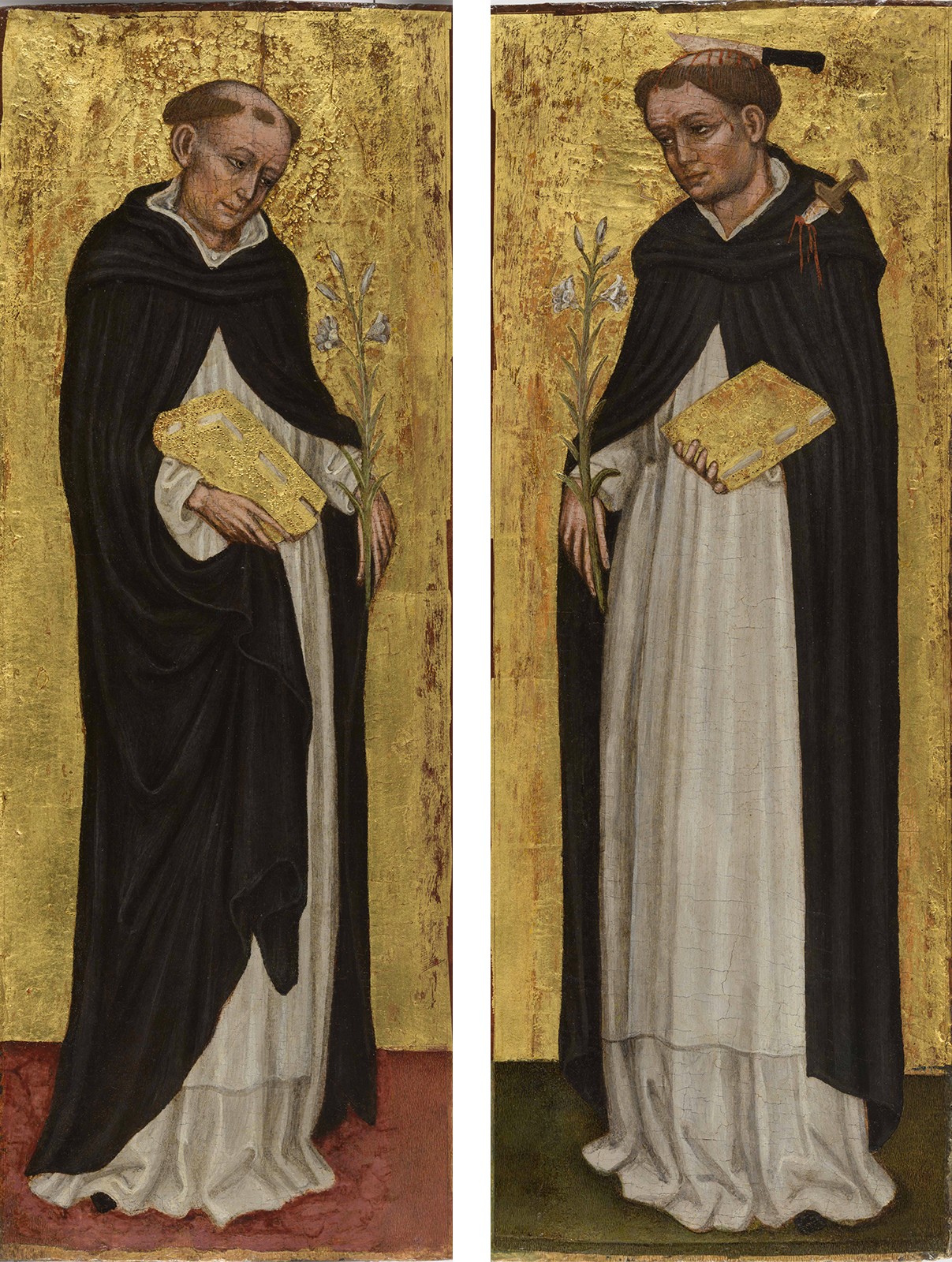
Zanino di Pietro (Giovanni Charlier)
(? c. 1370 - before 1443 Venice)
S. Dominin and S. Peter, c. 1430
tempera on panel, gold ground, 62 x 24,5 cm (24.41 x 9.65 inches)
Zanino di Pietro (Giovanni Charlier)
(? c. 1370 - before 1443 Venice)
S. Dominin and S. Peter, c. 1430
tempera on panel, gold ground, 62 x 24,5 cm (24.41 x 9.65 inches)
Re: 896
PROVENANCE
Parcieux (Ain), collection of Albin Chalandon (1809–85)
Lyon, private collection
LITERATURE
F. Zeri, Aggiunte a Zanino di Pietro, in “Paragone”, XIII, 1962, 153, pp. 56-60 (pp. 56-57)
V. Baradel, Zanino di Pietro. Un protagonista della pittura veneziana fra Tre e Quattrocento, Padua, 2019, p. 210, no. 23, pls. XLIV-XLV
Ead, Rileggendo le “Aggiunte a Zanino di Pietro”, in Federico Zeri: lavori in corso, ed. A. Bacchi, D. Benati, A. De Marchi, A. Galli and M. Natale, Bologna 2019, pp. 83-107 (pp. 88-89, figs. 8-9)
FOTOTECA ZERI
255617-255618
St. Dominic and St. Peter Martyr (Peter of Verona) are depicted in a full-figure, three-quarter pose, wearing the habit of the Order of Preachers. Both carry the order’s customary emblems: the fleur-de-lys, symbolising purity and Dominic’s special devotion to the Virgin, and the book, the symbol of wisdom. Peter can also be identified by the instruments of his martyrdom: a sword piercing his heart and a ‘falcastro’, a kind of reverse sickle, cleaving his head in the middle of his tonsure. The setting, reduced to a bare minimum, consists solely of the red and green floors on which the figures of the two saints are standing.
Domenico Guzmán and Pietro da Verona met at the University of Bologna. Pope Honorius III granted his official approval to the Dominican rule through the bull Religiosam vitam in 1216, and from that moment on, the community began to settle in cities that hosted universities, one of which was Bologna. Dominic went to Bologna in person, accompanied by such valid aides as Peter of Verona, whose family had embraced the Cathar heresy. Peter joined the order after being spellbound by Dominic’s eloquence and even attended the founder’s solemn funeral in 1221. Now a fierce opponent of heresies, Peter was despatched to Lombardy, home to numerous Cathar communities, and it was precisely the effective nature of his sermons that put him inexorably on the path to martyrdom. He was slain near Seveso by assassins hired by the heretic groups that he opposed. His cult, followed by his rapid canonisation, was frequently accompanied by the dissemination of his image alongside that of Dominic himself, whose first and most celebrated disciple he was rightly held to bei.
The two panels come from the Chalandon collection in Parcieux, close to Lyon, where they are recorded until the 1950sii. They were part of an outstanding collection as yet little known to scholarship. The collection’s creator was an army officer named Albin Chalandon (1809–85), the son of a wealthy merchant, who, from an early age, spent a great deal of time in Italy ferreting out works of art. In 1851, Chalandon had purchased part of the extensive collection of paintings and enamels belonging to the author and man of letters Alexis-François Artaud de Montor, who had in turn bought the works of art over the many years that he spent studying, chiefly in Tuscany. We know, for example, that Chalandon had acquired from the Artaud de Montor collection the celebrated small panel by Fra’ Angelico depicting the Meeting of Saint Dominic and Saint Francis of Assisi, subsequently in the Samuel H. Kress collection and now in the Fine Arts Museum of San Franciscoiii . The extent of the Chalandon collection, which was shared out among his children and grandchildren after his death, can easily be gauged from the fact that, in 1877, he lent fully 29 paintings to the sumptuous exhibition held in the Palais du Commerce in Lyon in that yeariv. He was especially enamoured of Tuscan 14th and 15th century painting, but his collection also included work by masters from other regions, such as a marvellous diptych of the Annunciation by Cola da Camerino, now in a private collection in Dallas (formerly London, Christie’s, 10 July 1992, lot 39)v, or the polyptych panels under discussion in this papervi. These panels were studied in the original collection in the early 1950s by Federico Zeri, who attributed them to the Venetian painter Zanino di Pietro. In Zeri’s famous essay on that master, published in the periodical “Paragone”, he dates the panels to the latter part of his career on the basis of a comparison with the Saints in a triptych (more probably, a polyptych panel) formerly in the parish church of Valcarecce and now in the cathedral of Cingoli in the Marchevii (fig. 1). As Zeri points out, it was precisely “Zanino’s debt to Gentile da Fabriano’s work in Venice” that allowed him to “date the panels to a later moment in the painter’s career”, probably c. 1430. Zeri’s view has been corrected in part by Valentina Baradel, who agrees that the panels are close to the Cingoli Saints, but in her view they clearly reveal a kind of return on Zanino’s part to the expressive strength of his time in Bologna, which was subsequently attenuated through contact with Gentile’s International Gothic style in Veniceviii. In that connection, Baradel also mentions another painting which she claims belongs to the same moment in Zanino’s career, a Crucifixion formerly in the Chillingworth collection and now in the Geneva offices of Swiss bank PKB (fig. 2)ix. What is certain is that the mastery of expression that Zanino learnt in Bologna, primarily through studying the work of Lippo di Dalmasio and Jacopo di Paolo, never failed him in the course of his career, although he interprets it from a ‘foreign’ viewpoint undoubtedly connected with the northern European sense of elegance that he had picked up in his youth.
This, because while it is true that Zanino is identified in Bolognese documents as a painter “de Veneciis” as early as in 1389, his French origin is mentioned on more than one occasion both in Venetian notary deeds from the early 15th century and in the scroll beneath the throne in the Madonna and Child Blessing now in the Museo Nazionale di Palazzo Venezia (fig. 3), a painting dated 1429, in which he still styles himself “Iohes de Francia”x. The combination of different formal influences, from the Bolognese masters and Altichiero to the French illuminated codices present in the scriptoria of both Bologna and Venice and, naturally, to Gentile da Fabriano, led Zanino to develop a highly personal style, in which a Late Gothic softness of line and glittering palette are offset by nervous, vibrant brushwork, which can clearly be seen in the panels under discussion here, particularly in the broken segments of the drapery and the eloquent curve of the two saints’ elongated hands. Zanino turned to Gentile for his sophisticated application and treatment of gold, which can be easily discerned in our case thanks to the panels’ excellent condition. Yet where Gentile invariably endeavours to mitigate his figures’ sharpness of mood by giving them a placid, unruffled feel, Zanino, turning to the painters of Bologna, produces images with figures that are astonishingly communicative. Our Dominican saints, their heads bowed and lines beginning to form on their faces, are limpid models of devotion. Indeed, their very pose tells us that the panels must have been the side panels of a polyptych, the centre of which was once occupied by a Madonna of Humility on whom all the lines formed by the two saints’ gazes would naturally have converged.
i For the historical figure of St. Peter Martyr, see M. Benedetti, entry Pietro da Verona, santo, in Dizionario biografico degli italiani, 83, Rome, 2015, pp. 556-559. For relations between Dominic and Peter Martyr, and for the Dominican Order’s early history, see the part on the order M. T. Dolso, Gli ordini mendicanti. Il secolo delle origini, Rome, 2021.
ii According to Federico Zeri, who mentions the fact at the beginning of his essay: F. Zeri, Aggiunte a Zanino di Pietro, in “Paragone”, XIII, 1962, 153, pp. 56-60 (p. 56).
iii C. B. Strehlke, in Painting and Illumination in Early Renaissance Florence 1300–1450, ed. L. Kanter, exhibition catalogue (New York, The Metropolitan Museum of Art, 17 November 1994 – 26 February 1995), pp 326, 331-332, n. 47d.
iv Exposition rétrospective de Lyon. Notice sommaire des tableaux et médailles exposés dans le Palais du Commerce, exhibition catalogue (Lyon, Palais du Commerce, 1877), Lyon 1877.
v C. Caldari, in Gentile da Fabriano e l’altro Rinascimento, ed. L. Laureati and L. Mochi Onori, exhibition catalogue (Fabriano, Spedale di Santa Maria del Buon Gesú, 21 April – 23 July 2006), Milan 2006, pp. 284-285, n. VI.11.
vi Many items of sumptuary art from the Chalandon collection were sold at a prestigious auction in Paris in 1913: Exposition d'objets d'art du moyen age et de la Renaissance; tirés des collections particulières de la France et de l'etranger organisée par la Marquise de Ganay à l'ancien Hotel De Sagen, Paris, 1913. For the collection of paintings, see: G. Migeon, La collection de Monsieur Georges Chalandon, in “Les arts”, IV, 1905, 42, pp. 17-29; L. Demonts, Une collection française de primitifs, in “Revue de l’art ancien et moderne”, LXX, 1936, pp. 247-250; J. F. Garmier, Le goût du moyen âge chez les collectionneurs lyonnais du XIXe siècle, in “Revue de l’art”, XLVII, 1980, pp. 53-64; S. Lecoq Ramond, F. R. Martin, Le goût pour les primitifs à Lyon au XIXe et au début du XXe siècle, in Le temps de la peinture. Lyon 1800-1914, exhibition catalogue (Lyon, Musée des Beaux-Arts, 20 April – 30 July 2007), Lyon, 2007, pp. 110-123.
vii F. Zeri, Aggiunte a Zanino di Pietro, in “Paragone”, XIII, 1962, 153, pp. 56-57. For the Cingoli Saints, see also: R. Mandolini, L’Incredulità di Tommaso descritta da Zanino di Pietro nel polittico di Mombaroccio, in Il Santuario del B. Sante a Mombaroccio di Pesaro, Rome, 1998, pp. 125-171 (p. 151).
viii V. Baradel, Zanino di Pietro. Un protagonista della pittura veneziana fra Tre e Quattrocento, Padua, 2019, p. 210, n. 23.
ix V. Baradel, Rileggendo le “Aggiunte a Zanino di Pietro”, in Federico Zeri: lavori in corso, ed. A. Bacchi, D. Benati, A. De Marchi, A. Galli and M. Natale, Bologna 2019, pp. 83-107 (pp. 87-88, fig. 2).
x M. Natale, entry Charlier, Giovanni, in Dizionario biografico degli italiani, 24, Rome, 1980, pp. 377-380. For the panel in the Museo Nazionale di Palazzo Venezia, see: V. Baradel, Zanino di Pietro. Un protagonista della pittura veneziana fra Tre e Quattrocento, Padua, 2019, pp. 214-216, n. 26, pl. XLVIII.