

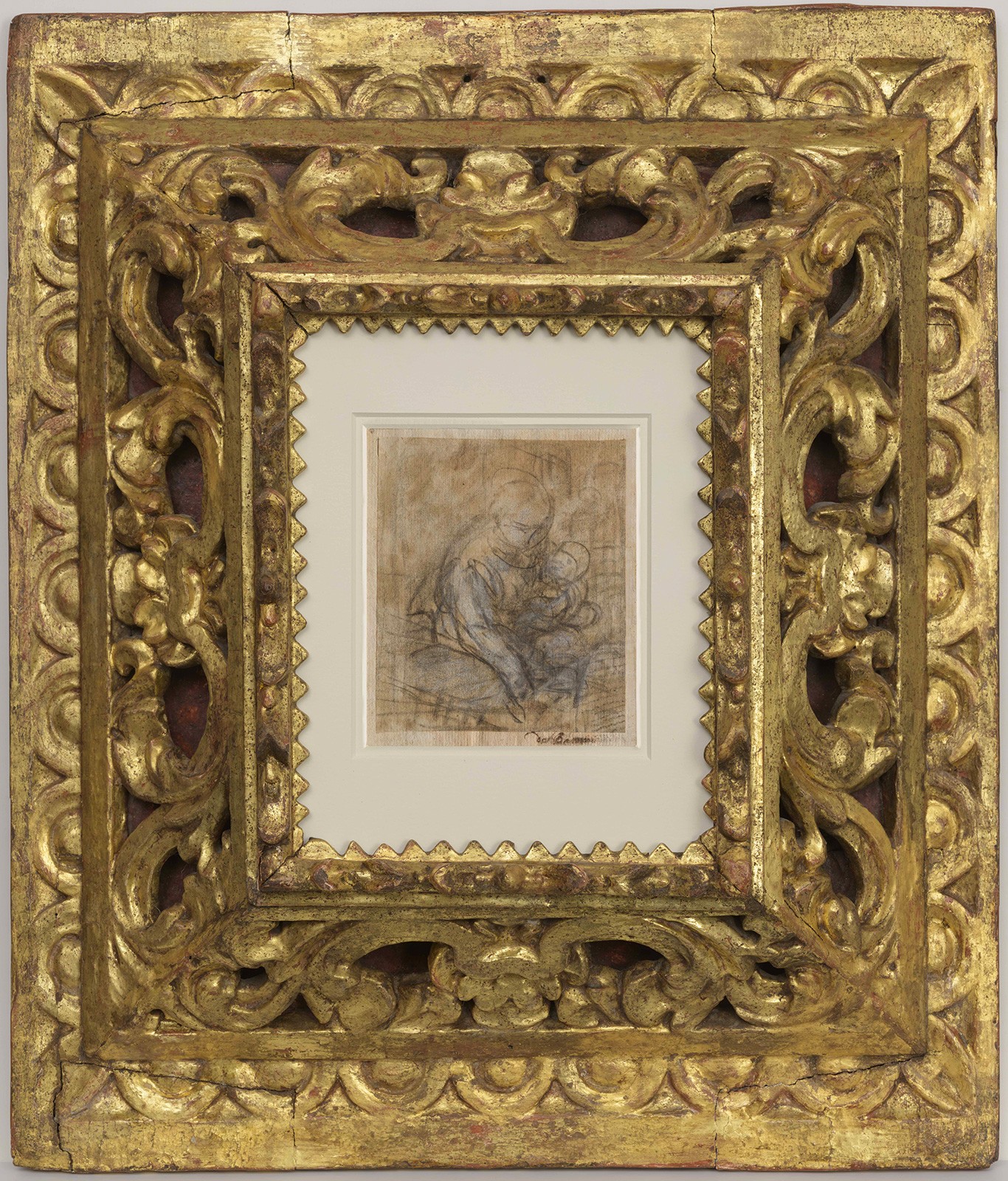
Federico Barocci
(Urbino 1535 - 1612 Urbino)
Study for the Madonna Albani, c.1600
black chalk, heightened in white, on yellowed paper, 13,5 x 11,5 cm (5.31 x 4.53 inches)
Federico Barocci
(Urbino 1535 - 1612 Urbino)
Study for the Madonna Albani, c.1600
black chalk, heightened in white, on yellowed paper, 13,5 x 11,5 cm (5.31 x 4.53 inches)
Re: 930
The sheet is attached to two backing papers, at the base of one of which is inscribed ‘del Barocci 63’ in an old, eighteenth-century hand.
Provenance
Casa Albani
Rome, Vincenzo Camuccini
Cantalupo in Sabina Baroness Emma Dantoni Cammuccini
Sotheby’s, Florence, 18 October 1969, lot D 75
Calenzano, Loriano Bertini collection
Milan, Finarte, 4 December 1986, lot 288
Private collection
Literature
Andrea Emiliani, Mostra di Federico Barocci, Museo Civico, Bologna, 14 September-16 November 1975, exh. cat., pp. 240-44, nos. 297-305, pp. 241-42, no. 300, illustrated.
Andrea Emiliani, Federico Barocci (Urbino 1535-1612), 2 vols., Bologna, 1985, pp. 420-27, figs. 929-44, p. 427, fig. 942, illustrated.
John Shearman, ‘Barocci at Bologna and Florence’, Burlington Magazine, vol. CXVIII, no. 874, January 1976, pp. 49-54, p. 51, both for the painting and for the present drawing.
Luisa Vertova-Nicolson, ‘Un “disegno compiuto” del Baroccio per la Madonna della Culla di casa Albani’, Antichità Viva, vol. XXVIII, nos. 2-3, 1989, pp. 26-34. See pp. 28-34, figs. 3-15, for the Madonna Albani, and pp. 32-33, fig. 11, for the present drawing
Andrea Emiliani, Federico Barocci (Urbino 1535-1612), 2 vols., Ancona, 2008, pp. 353-59, nos. 87.1-87.23, p. 358, fig. 87.15, illustrated
L. Baroni, Federico Barocci and the Madonna Albani. A rediscovered sketch, 2026
First presented in the memorable 1975 Barocci exhibition in Bologna, and published and reproduced in its catalogue, the present drawing is a study for Federico Barocci’s Madonna Albani in the collection of the Banca Nazionale del Lavoro in Rome, which is universally agreed to be one of the artist’s last inventions1 Indeed, it is one of no fewer than twenty-three sheets to have been associated with the canvas, which only underlines the fact that Barocci’s extraordinarily prolific production of drawings continued until the very end of his exceptionally long career2. The main focus of the composition is the Madonna with her tenderly sleeping Child in the left foreground. Her right arm is stretched out in order to make the cradle ready for her Son, while to either side her own bed and her work basket are just visible. In a room beyond to the right, we see Joseph sharpening what appears to be his saw on a metal wheel and accompanied by a female figure, presumably some kind of assistant, who is kneeling on the ground. The pairing of the Virgin’s work basket and Joseph busy with his carpentry are motifs almost certainly inspired by Correggio’s Madonna of the Basket, now in the National Gallery in London, but which Barocci would have seen in the Baiardo collection in Parma, a panel whose iconography was in its turn derived from a woodcut from Albrecht Dürer’s Marienleben3.
Regardless of whether every single one of the drawings that have been associated with the Madonna Albani is actually a preparatory study for it, it is clear that – unsurprisingly - the overwhelming majority of them were made in order to determine the disposition of the two main figures in the foreground4. They indicate that Barocci did not immediately resolve to represent the Infant Christ on the proper left of the Madonna, nor indeed to show him asleep5. Within those that conform to the final arrangement, the present drawing, which is remarkable for its exploratory freedom of handling and numerous exploratory changes of mind, must unquestionably be one of the earliest, but already hints at what will become the narrative beyond with Joseph. Only one other drawing, a sheet in the Biblioteca Comunale in Urbania, so excitingly reveals the artist – so to speak – thinking out loud on paper, but its inclusion of the cradle leaves no doubt that it must come later in the sequence of execution, for all that it does not explore the background scene6.
There is a lack of consensus concerning how much of the final painting’s present appearance is the work of the artist, above all as a result of various eighteenth-century sources which refer to a long Latin inscription that at that time filled the space in the bottom left-hand corner always intended for the Infant Christ’s cradle, which is now to be seen there, and must therefore be a later modification added long after Barocci’s day7. Be that as it may, it seems important to reiterate that there has never been any doubt expressed about Barocci’s responsibility for the composition, not least because of the numerous autograph drawings for it to have survived.
1 Emiliani 1975, pp. 241-42, no. 300, and Emiliani 2008, pp. 353-59, nos. 87.1-87.23, for the painting and the related drawings. For the present drawing, see p. 358, fig. 87.15, illustrated, and Vertova-Nicolson 1989, pp. 32-33, fig. 11
2 Ekserdjian 2018, for the sheer number of Barocci’s drawings in his post mortem inventory.
3 Vertova-Nicolson 1989, pp. 28-34, for a detailed examination of these drawings, a number of which she does not believe to be connected with the Madonna Albani
4 Emiliani 2008, p. 355, no. 87.4, for the former, and p. 354, no. 87.1, and p. 357, no. 87.7, for the latter
5 Emiliani 2008, p. 359, no. 87.18, Bianchi 1959, no. 15, illustrated, and Vertova-Nicolson 1989, p. 33, fig. 14
6 Shearman 1975, p. 51, writes that ‘If the Madonna Albani is Barocci’s it must be accounted for by a senility which somehow did not affect his latest works, the Assunta, the Commiato from Chantilly or the Lamentation from Bologna’, while Agosti 2025, p. 290, expresses even graver doubts: ‘è assai ostico ricondurre a lui l’esecuzione del quadro’
7 Shearman 1975, p. 51, writes that ‘If the Madonna Albani is Barocci’s it must be accounted for by a senility which somehow did not affect his latest works, the Assunta, the Commiato from Chantilly or the Lamentation from Bologna’, while Agosti 2025, p. 290, expresses even graver doubts: ‘è assai ostico ricondurre a lui l’esecuzione del quadro’