

Laura Piranesi
(Rome 1754 - after 1789 Rome)
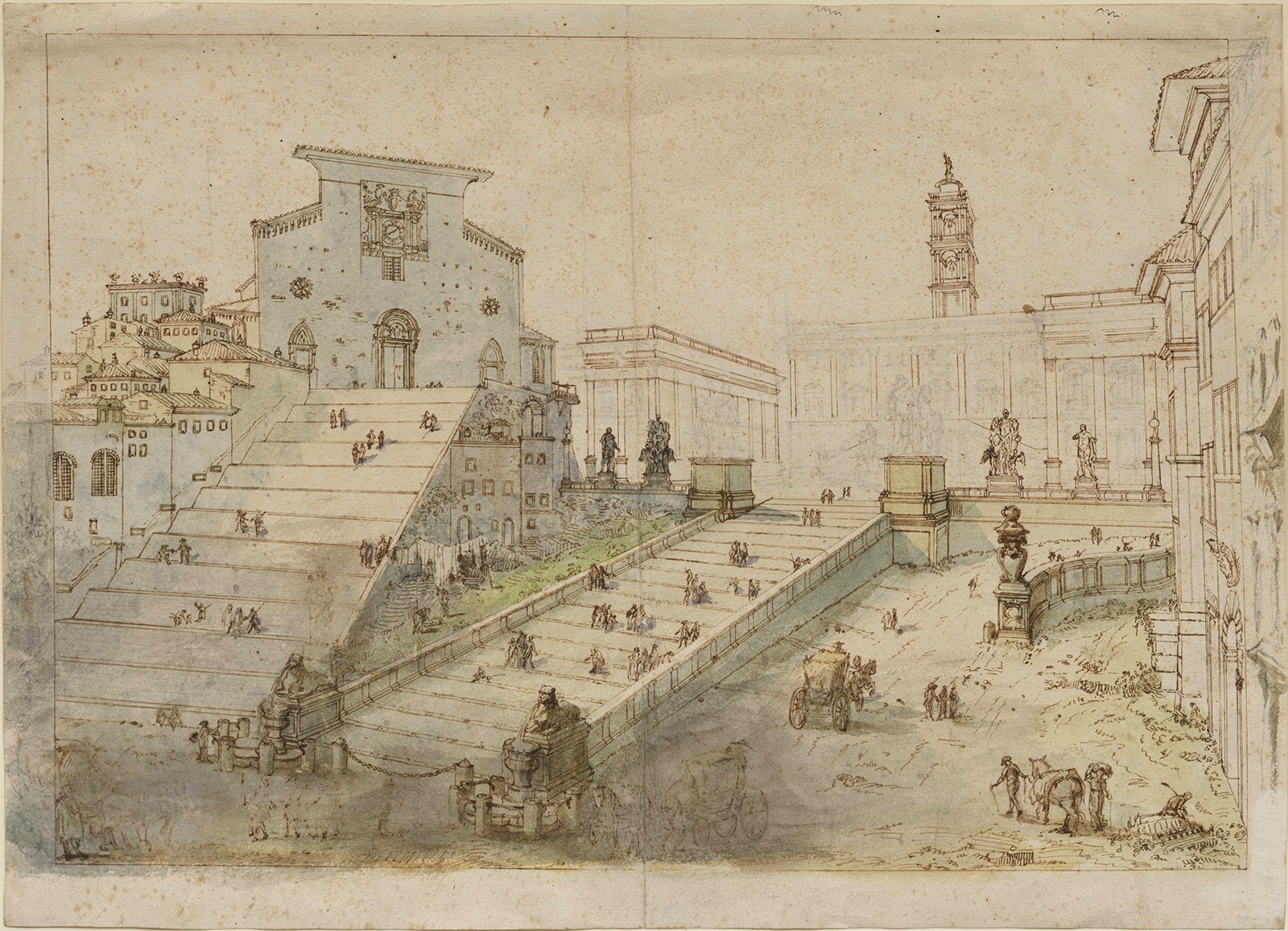
Rome, the Campidoglio and Santa Maria d'Aracoeli c. 1770
black chalk, pen, ruler and brown ink, brush and diluted brown ink, green, pink and blue watercolour on white paper, 34,2 x 47,9 cm (13.46 x 18.86 inches)
Laura Piranesi
(Rome 1754 - after 1789 Rome)
Rome, the Campidoglio and Santa Maria d'Aracoeli c. 1770
black chalk, pen, ruler and brown ink, brush and diluted brown ink, green, pink and blue watercolour on white paper, 34,2 x 47,9 cm (13.46 x 18.86 inches)
Re: 933
Provenance
Private collection
The drawing, executed on a squared sheet using pen, ruler, and brown ink, delicately watercolored, can be considered the first stage of graphic elaboration by Laura Piranesi (1754–1789), based on an invention by her father Giovanni Battista Piranesi (Venice 1720 – Rome 1788), View of the Roman Capitoline Hill with the Stairway Leading to the Church of Aracoeli, featuring architecture by Michelangelo Buonarroti. This work is part of the Vedute di Roma series, which was begun around 1747 and gradually expanded to a total of 138 plates.
The decision to reproduce the Capitoline Hill as part of a series of small-format views, etched in aquatint and based on her father's work—the only known evidence to date of Laura Piranesi’s production—reflects the intent to pay tribute to the most iconic landmarks of the Roman Empire. In antiquity, the hill was renowned as the site of the Temple of Saturn, where Hercules is said to have led the Greeks, and, during the Augustan age, as the location of the Temple of Mars Ultor. By the eighteenth century, it had acquired its present-day, fascinating stratification of historical eras: the 14th-century Church of Santa Maria in Aracoeli, annexed to an important Franciscan convent and to the tower of Pope Paul III (later destroyed during the 19th-century renovations); the grand Cordonata staircase designed by Michelangelo leading to the Palazzo Senatorio; the Palazzo dei Conservatori; and the Palazzo Nuovo by Girolamo and Carlo Rainaldi.
The site had already been chosen by Lievin Cruyl (Ghent, c. 1634 – 1720), who in 1665 created his preparatory drawing for the engraving Campidoglio to illustrate the structural innovations carried out under the pontificate of Alexander VII. It was later selected by Gaspar van Wittel (Amersfoort, 1653/4 – Rome, 1736) for his View of the Capitoline and the Aracoeli, Rome, around 1682—a masterpiece from his early graphic production. Finally, Canaletto (Venice, 1697 – 1768) depicted the site during his Roman stay in 1719–1720, producing a composition now preserved in an album at the British Museum in London. This is the only sheet that was later removed by his nephew Bernardo Bellotto, who took it with him across Europe and used it as inspiration for his own version, completed in Rome in 1742, which is now housed in Warsaw.
The geometric structure and bold perspective that Giovanni Battista Piranesi intended to achieve through the diagonal lines of the Cordonata—greatly widening the space to the right to show the route taken by carriages and passersby—is precisely echoed by Laura. Using a ruler, she draws the main architectural lines, outlines the Capitoline Hill and the austere façade of the church, and, with a free hand, sketches the grotesque masks on the façade, the Baroque volutes, and the lions at the base of the staircase, with meticulous attention to every figurative detail.
She sketches the figures—numerous lively characters that animate the scene—with a quick, sharp touch and a generous use of ink, typical of her father’s style. The outlines of the statues of the Dioscuri and the windows of the Capitoline buildings are drawn in black chalk, but left unfinished, as are the carriages in the foreground—elements that reappear in the etching executed by the artist based on this very drawing, inscribed Veduta del romano Campidoglio and Laura Piranesi incise, a version of which is held at the British Museum in London. By dramatizing the composition through a bold use of ink on the etched plate, Laura imparts a heightened sense of structure and chiaroscuro play to the view—an indelible memory of Rome.
In the drawing, Laura studies the tufts of vegetation growing on the ground and applies watercolor in green, blue, and pink to certain areas in order to lend a painterly quality to the scene—likely with the intention of turning it into a collectible sheet. This approach follows a widely popular tradition initiated by Van Wittel in the 1720s, specifically with his imagined views, further developed in the refined capriccio drawings of Giovanni Paolo Panini (Piacenza 1691 – Rome 1765), and later, in the 1760s, by his student Hubert Robert (Paris 1733 – 1808). The practice continued into the 1780s with the modern, color-filled depictions of Jean-Louis Desprez (Auxerre 1743 – Stockholm 1804), sometimes created in collaboration with Francesco Piranesi.
Training at Palazzo Tomati with Giovanni Battista Piranesi
From the late 1750s, Giovanni Battista Piranesi saw his fame grow steadily, secured on the international stage by the Antichità Romane and the first fifty-nine plates of the Vedute di Roma—works that brought him new and significant commissions from enthusiasts and connoisseurs visiting the Eternal City.
From his marriage to Angelica Pasquini, daughter of the Corsini family's gardener, Laura was born in 1754, followed by Francesco in 1761—the first of five children. These were the years in which the eclectic artist received honors and recognition: he was named a member of the Society of Antiquaries (1757) and of the Accademia di San Luca (1761). He moved from Via del Corso—a location closely tied to the French Academy—to the more vibrant and stimulating Strada Felice (now Via Sistina), near Trinità dei Monti, an area inhabited by fellow artists, colleagues, and travelers. At Palazzo Tomati, which also housed his new print workshop, he fully embraced his mission to celebrate the Eternal City, taking an active role in the debate over the primacy of Greek versus Roman art.
His work became the primary vehicle for the systematic dissemination of a magniloquent image of papal Rome, as well as of the grand and unsettling vision of ancient “speaking ruins.” It also served as a medium for a new understanding of the city and its history. As the children grew up in the atmosphere of the combined household and workshop—during a time of increasingly intense and diversified production, supported by a growing team of collaborators—their education was immediately oriented toward future collaboration. Immersed in the cult of antiquity, Francesco studied landscape with the Hackert brothers, architecture with Pierre-Adrien Paris, and engraving with Giovanni Volpato. He began contributing to the final preparatory stages of the Paestum plates and to the volumes on the Trajan and Antonine Columns, later publishing numerous supplements to the Antichità Romane and compiling a complete catalogue of the works printed up to that time (1792).
When he moved to Paris with his brother Pietro, he founded the Calcographie des Piranesi Frères, which achieved notable success, reprinting much of their father’s graphic oeuvre in 27 volumes between 1800 and 1807, and producing terracotta replicas of antiquities from the museum at Palazzo Tomati. Unfortunately, the education of the daughter, Laura, is less well documented. However, we can state with certainty that she learned the techniques of etching around 1770, as Giovanni Ludovico Bianconi wrote that in Piranesi’s workshop “one of his daughters elegantly engraves following the distinctive style of her father,” and later, Gori Gandellini noted that “Laura was no less accomplished than her brother in etching and burin engraving; her prints are very graceful.”
Laura’s work stands as an exceptional assertion of artistic autonomy, as well as of her personal engagement with printmaking. She chose her father’s Vedute di Roma as her subject, but reinterpreted them in postcard format (approx. 13 ? 20 cm), and cleverly played on the homophony with the Italian verb lavorare (“to work”) by signing her prints “Laura Piranesi inc.”, “Laura sculp.”, “Laura Piranesi incise”, or even “Lavora Piranesi.” In two cases, Laura deliberately altered her father’s original viewpoint, offering her own interpretation: in the views of the Temple of the Sibyl and Castel Sant’Angelo.
Her figures remain deeply influenced by the style of Giovanni Battista, as if he had imposed a modus operandi from which one could not depart. Sharp-edged shadows and elongated limbs also populate her engravings and are clearly recognizable in the present drawing, albeit in miniature. To adapt the composition to the smaller format of the support—as, for example, in the view of San Giovanni in Laterano—the theatrical effect is softened compared to her father’s model, through the reduction of the shaded foreground area. While the sky's atmosphere may appear less turbulent in Laura’s prints, in the view of Castel Sant’Angelo she nonetheless demonstrates her technical mastery. With their more intimate character, these works are closer in spirit to the small-scale views from her father’s early career or to the Antichità Romane series (1756).
Like the prints signed by Francesco, Laura’s works must also have been published after 1778, likely alongside new editions of her father’s series. Nevertheless, the project she undertook failed rather quickly—perhaps due to financial difficulties, tensions with her brother, or the intense competition in the print market at the end of the century. Between 1780 and 1783, Laura and her husband faced economic hardship caused by debt and disputes with her brother over their father’s inheritance. Set within the broader context of the flourishing production of view collections of Roman monuments between the late 18th and early 19th centuries—such as the celebrated series by Jean Barbault—Laura’s prints contributed to the enduring visual and editorial success of her father’s Vedute. Among the many imitators who never managed to match Giovanni Battista’s mastery, Laura stood out as one of his closest and most talented followers, and as one of the rare female engravers of her time. She also distinguished herself as a sensitive draughtswoman, practicing watercolor as a way to explore new artistic forms and leaving behind a distinctive personal mark.