

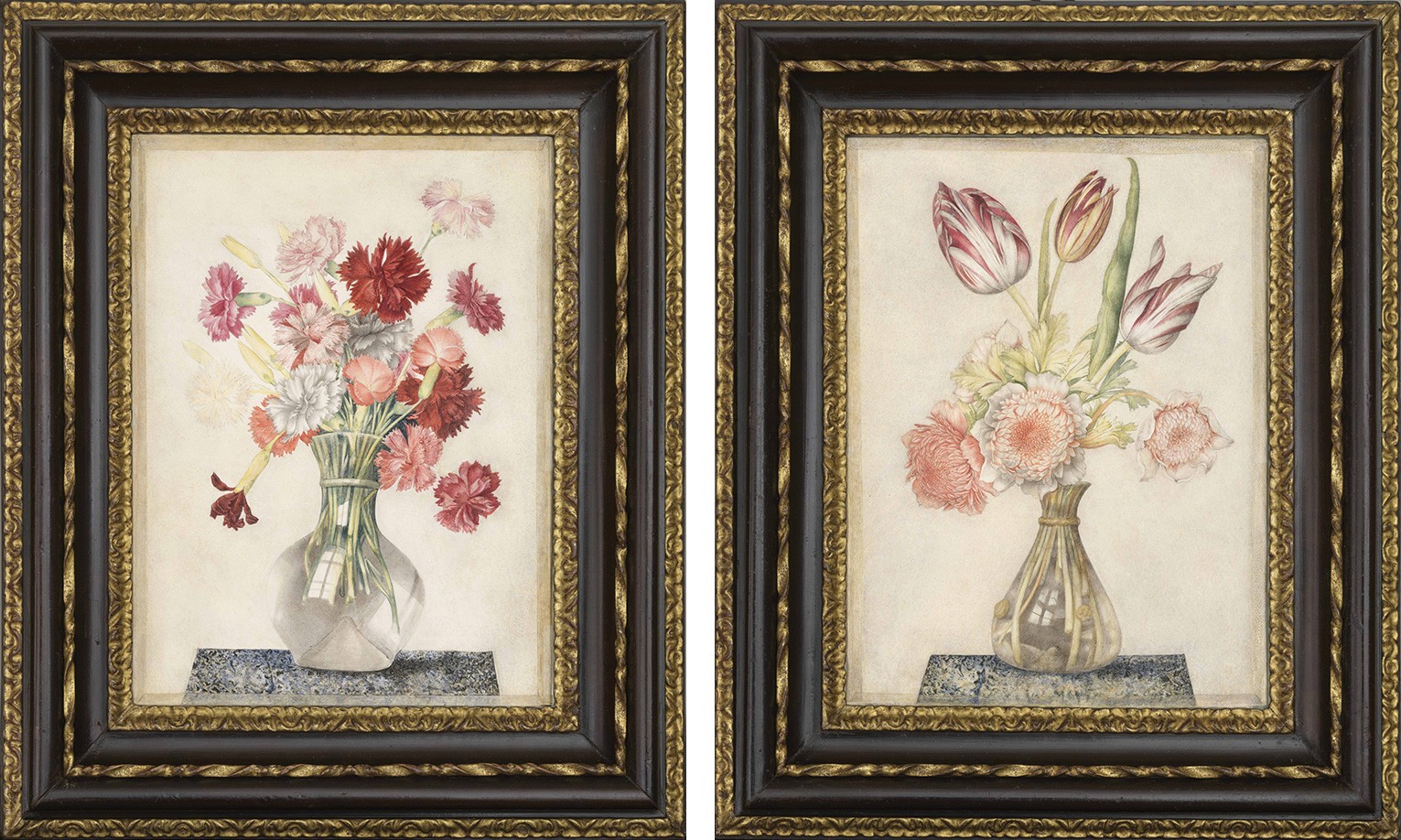
Giovanna Garzoni
(Ascoli Piceno 1600 - 1670 Rome)
Glass Buffone with White, Pink, Orange and Red Carnations on a Marble Base - Burnished Glass Buffone with Carnations and Tulips on a Marble Base, c. 1645
tempera on vellum, 35,5 x 26,8 cm (13.98 x 10.55 inches)
Giovanna Garzoni
(Ascoli Piceno 1600 - 1670 Rome)
Glass Buffone with White, Pink, Orange and Red Carnations on a Marble Base - Burnished Glass Buffone with Carnations and Tulips on a Marble Base, c. 1645
tempera on vellum, 35,5 x 26,8 cm (13.98 x 10.55 inches)
Re: 936
Provenance
Count Carlo Francesco Bonfioli, Bologna, 1669
Private collection
We are grateful to Professor Lucia Tongiorgi Tomasi, national fellow of the Accademia Nazionale dei Lincei, for confirming the attribution of the vellums to Garzoni, after examining them in person.
We are grateful to Professor Enrico Banfi for conducting the expert analysis of the botanical species represented in the works.
Two buffoni vases, the first broader in body and of transparent crystal, the second of burnished glass and pear-shaped, hold respectively a cluster of white, red, pink, and orange carnations, and a composition of chrysanthemums and tulips with red and white striations. Both vessels rest upon precious blue marble ledges reminiscent of those produced in the seventeenth century at the Opificio delle Pietre Dure in Florence.1 On the burnished glass vase, two snails appear, their shells protruding from the body of the vessel as though they were precious ornaments.
The two paintings, executed in tempera on vellum over black chalk underdrawings, are of nearly identical dimensions: they therefore formed part of the same series, and are manifestly works from the mature period of the painter and miniaturist Giovanna Garzoni.2 Born in Ascoli Piceno to a Venetian family, Giovanna Garzoni moved as a young woman to her parents’ city of origin, where she trained as a painter, very likely in the school of Jacopo Palma il Giovane. It was perhaps the enchantment of the emporiums of the Serenissima, where goods, plants, and fruits from every corner of the world converged, that kindled Giovanna’s fervent imagination from adolescence. Yet, in keeping with the paradigm of the woman artist that had established itself over the course of the sixteenth century, and that in Venice itself had found luminous exemplars in Irene da Spilimbergo and Marietta Robusti, Giovanna Garzoni, at least according to the testimony of Carlo Ridolfi,3 first applied herself to singing and learning the spinet, while simultaneously leaving evidence of her precocious artistic talent in small miniature portraits and self-portraits.4 Her first sojourn in Florence, between 1618 and 1621, came at the invitation of Grand Duchess Maria Maddalena at the Medici court, and it was very likely during this period that the Marchigian artist first encountered Artemisia Gentileschi.5 Still more significant was Garzoni’s second Florentine sojourn, between 1642 and 1651, when the artist, now at the height of her career, had already gained renown as an outstanding interpreter of both portraiture and still life. This lengthy stay in Florence was marked by her work for Ferdinando II de’ Medici and, above all, for his wife Vittoria della Rovere.6 During these years, Giovanna Garzoni engaged in a kind of silent contest with the models left in the Medici collections some half a century earlier by Jacopo Ligozzi in his corpus of nature illustrations. Yet where the intent of Ligozzi’s miniatures had been essentially scientific in character, linked to the interests of Grand Duke Francesco I and his associate, the botanist Ulisse Aldrovandi, Giovanna Garzoni reinterprets the theme of simulated plants and flowers in a more decorative vein. This is not to suggest that her investigation of species was any less rigorous in descriptive accuracy; yet the quality of her compositions betrays an awareness of early seventeenth-century Lombard painting and, above all, a deep familiarity with the Flemish and Dutch masters of still life. In this respect, Giovanna Garzoni’s art presents an analogy to the literary writings of the scientists who, a generation later, would give rise, again in Florence, to the Accademia del Cimento: scholars trained in an empirical mode of inquiry that nonetheless remained open to the pleasure of the non-specialist reader.7
Our paintings, left in certain passages in a state of sketch, the better to convey a more vivid quality of expressive immediacy, can be dated to the second half of the 1640s. This is confirmed by comparison with the Glass Buffone with Various Flowers on a Stone Base with a Peach, a work executed for Cardinal Leopoldo de’ Medici in 1647–48 and today preserved in the Gabinetto dei Disegni e delle Stampe of the Uffizi (inv. no. 2151 Orn.).8 To the same phase belong a series of Garzoni’s paintings of Glass Vases with Various Flowers on Rocky Bases, whose provenance from the collections of Grand Duchess Vittoria is documented (Galleria degli Uffizi, invs. 1890/7315 and 1890/4783; Gabinetto dei Disegni e delle Stampe, invs. 2138, 2140, and 2141 Orn.).9 The profile of a window reflected in both vessels, a device that appears equally in the painting formerly belonging to Cardinal Leopoldo, recalls the still lifes of Caravaggio (the Boy Bitten by a Lizard) and his earliest followers. Yet the meticulous rendering of the flowers, identified by Professor Enrico Banfi as specimens of Dianthus caryophyllus (the carnations) and Tulipa agenensis (the tulips), species now virtually extinct owing to the genetic selection of recent centuries, reveals Garzoni’s engagement with the Flemish masters, above all the Antwerp-born Ambrosius Bosschaert (1573–1621) and Roelant Savery (1576–1639), whose works were present in the Medici grand-ducal collections by the mid-seventeenth century.10 It is precisely in her pursuit of tactile verisimilitude that the artist’s rendering of the snail shells on the vase of chrysanthemums and tulips proves so remarkable: tangible illusions of a reality that is itself illusory, and hence candid allusions to the biblical theme of Vanitas, whereby the life of man becomes inevitably a mirage and a deception. The use of gold dust to define the shells further emphasises their luminous reflections, deepening the sense of chimera that pervades these details.
A final surprise lay concealed on the verso of the vellum with the Buffone with Tulips: adhered to it was a letter, dated 16 January 1669, containing expressions of gratitude, addressed to a recipient who unfortunately remains unidentifiable, as the document is fragmentary and in places illegible, from Count Carlo Francesco Bonfioli of Bologna. The letter was directed to Rome, to a gentleman residing in the parish of Santa Maria Nova, that is, the Basilica of Santa Francesca Romana in the area adjacent to the Forum. It is entirely plausible to conclude, therefore, that the vellums too were a gift, a token of the gratitude that Bonfioli evidently felt toward his correspondent. The fact that they were mounted from an early date onto copper plates underscores their character as precious offerings, and the antique Roman frames in which they are set may furnish additional corroboration for the provenance attested in this important document. The letter thus illuminates an episode of collecting directly connected to these works, all the more significant in that it dates to a period when Garzoni was still alive and active.
Notes
1 For a brief account of the history of the Opificio and the masterworks preserved in this foundation's museum, see: A. Giusti, Il Museo dell'Opificio delle Pietre Dure. Capolavori, Livorno 1996.
2 On Giovanna Garzoni: A. Cipriani, Giovanna Garzoni, miniatrice, in “Ricerche di storia dell’arte”, 1/2, 1976, pp. 241–254; S. Meloni Trkulja, Giovanna Garzoni miniatora medicea, in “FMR”, 1983, 15, pp. 77–96; G. Casale, Giovanna Garzoni “Insigne miniatrice” 1600–1670, Milano 1991; Id., voce Garzoni, Giovanna, in Dizionario biografico degli italiani, 52, Roma 1999, pp. 432–435; “La grandezza dell’universo” nell’arte di Giovanna Garzoni, ed. S. Barker, exhibition catalogue (Florence, Galleria degli Uffizi, 28 May – 28 June 2020), Livorno 2020.
3 C. Ridolfi, Le maraviglie dell’arte, overo le vite de gl’illustri pittori veneti, e dello stato, Venezia 1648, p. 71.
4 Evidence of this early phase of activity survives in the Self-Portrait as Apollo, now in the collections of the Palazzo del Quirinale: L. Morozzi, in La Reggia di Venaria e i Savoia. Arte, magnificenza e storia di una corte europea, ed. E. Castelnuovo, exhibition catalogue (Turin, Reggia di Venaria Reale, 12 October 2007 – 30 March 2008), Turin 2007, II, p. 177, no. 9.22.
5 On the possible friendship between the two painters, see: R. W. Bissell, Artemisia Gentileschi and the authority of art. Critical reading and catalogue raisonné, University Park (Pennsylvania) 1999, pp. 106–108.
6 On Garzoni’s work for Grand Duchess Vittoria della Rovere, see S. Barker, Le opere di Giovanna Garzoni in una Wunderkammer medicea. La Stanza dell’Aurora di Vittoria della Rovere, in “La grandezza dell’universo” cit., 2020, pp. 196–211, nos. 41–60.
7 On the Accademia del Cimento and its relationship to art and literary culture in Florence, see the essays in Scienziati a corte. L’arte della sperimentazione nell’Accademia Galileiana del Cimento (1657–1667), ed. P. Galluzzi, exhibition catalogue (Florence, Galleria degli Uffizi, 18 March – 18 June 2001), Livorno 2001.
8 E. Acanfora, in Pergamene fiorite. Pitture di fiori dalle collezioni medicee, eds. M. M. Simari and E. Acanfora, exhibition catalogue (Poggio a Caiano, Villa Medicea, 13 September – 14 December 2014), Livorno 2014, pp. 56–59, no. 4; S. Barker, in “La grandezza dell’universo” cit., 2020, pp. 154–155, no. 19.
9 S. Meloni Trkulja, E. Fumagalli, Giovanna Garzoni. Nature morte, Paris 2000, pp. 20–27.
10 On Ambrosius Bosschaert and his family workshop, see L. J. Bol, The Bosschaert dynasty, painters of flowers and fruit, Leigh-on-Sea 1960; A. Splinters, The Painters of the Bosschaert Dynasty, in S. Segal, K. Allen, Dutch and flemish flower pieces: paintings, drawings and prints up to the nineteenth century, Leiden, Boston 2020, I, pp. 265–288. On Roelant Savery: Roelandt Savery. A painter in the services of emperor Rudolf II, ed. O. Kotková, exhibition catalogue (Prague, Národní Galerie, 8 December 2010 – 20 March 2011), Prague 2010.