

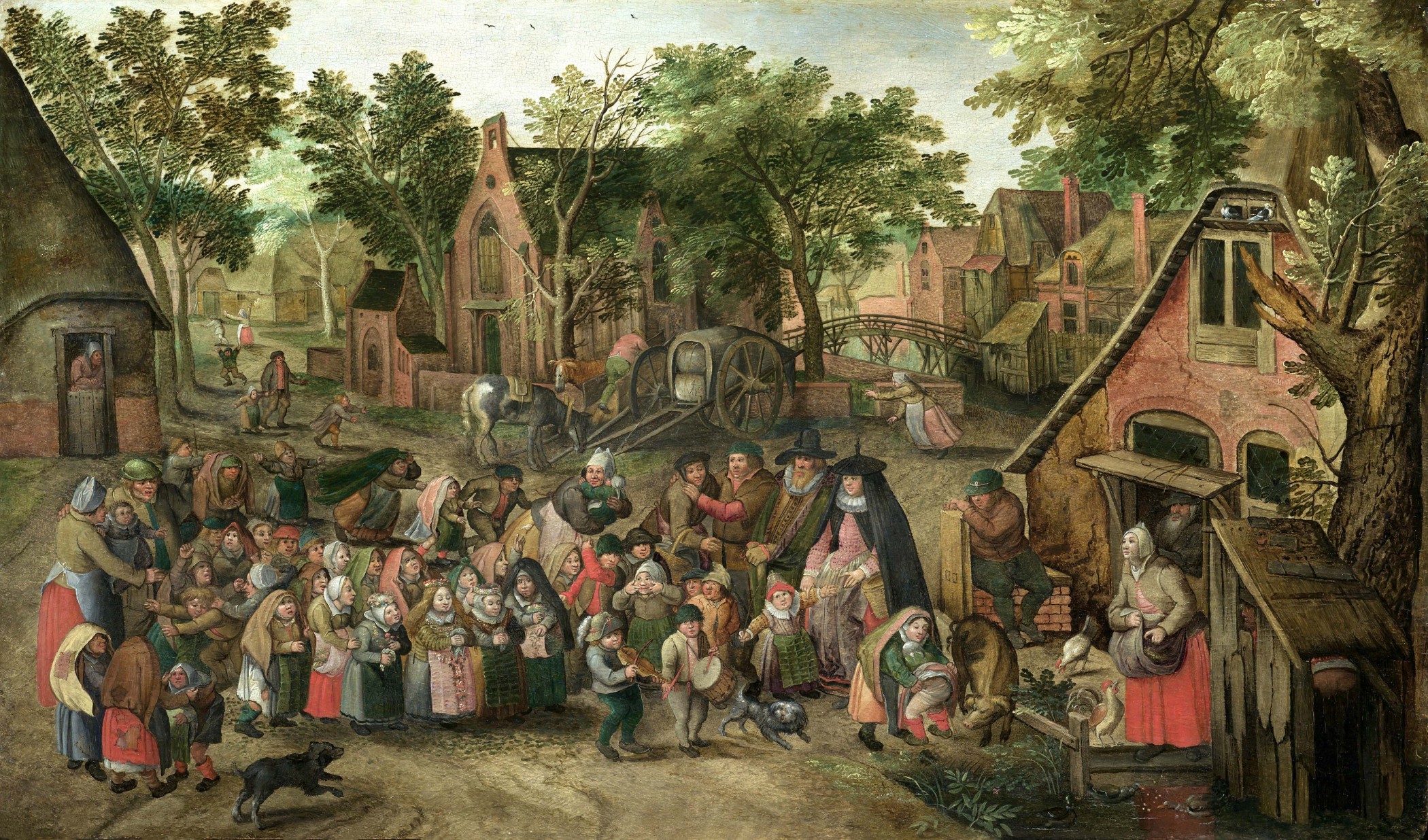
Pieter Brueghel, the Younger
(Bruxelles 1564 - 1637-1638 Antwerp)
The White Sun Bride, c. 1616
oil on panel, 45,2 x 75,4 cm (17.80 x 29.69 inches)
Pieter Brueghel, the Younger
(Bruxelles 1564 - 1637-1638 Antwerp)
The White Sun Bride, c. 1616
oil on panel, 45,2 x 75,4 cm (17.80 x 29.69 inches)
Re: 937
Provenance
Bruxelles, Private collection
The wooden panel is executed in the typical glazing technique characteristic of Flemish painting, whereby, in a final stage of execution, the white highlights visible in the uppermost paint layer were applied.
The subject depicts a traditional custom. During Pentecost, children went from house to house through the streets and were rewarded with small gifts for their singing, much as children still do today on St. Martin's Day, going from house to house singing and receiving sweets.
The prototype of this composition derives from David Vinckboons, who produced several versions shortly after 1600. Besides the work of his father, Pieter Bruegel the Elder, the paintings of Marten van Cleve, Pieter Balten, and especially David Vinckboons were of great importance to Pieter Brueghel the Younger. Vinckboons' popular peasant scenes, such as "The Bagpiper," "The Blind Hurdy-Gurdy Player," and "The Pentecost Bride," were his own inventions and served as models for Pieter II's later compositions.
Pieter Brueghel the Younger possessed considerable technical skill and a talent for a genre painting style that was often caricatural and deliberately exaggerated. Among the themes frequently encountered in his work is that of the "Children's Wedding" or "Pentecost Bride," presented as a festive performance set within a rural landscape.
Two versions signed BREVGHEL are known. This indicates that the subject was taken up by Pieter II after 1616, since prior to 1616 he signed his works without exception BRVEGHEL.