

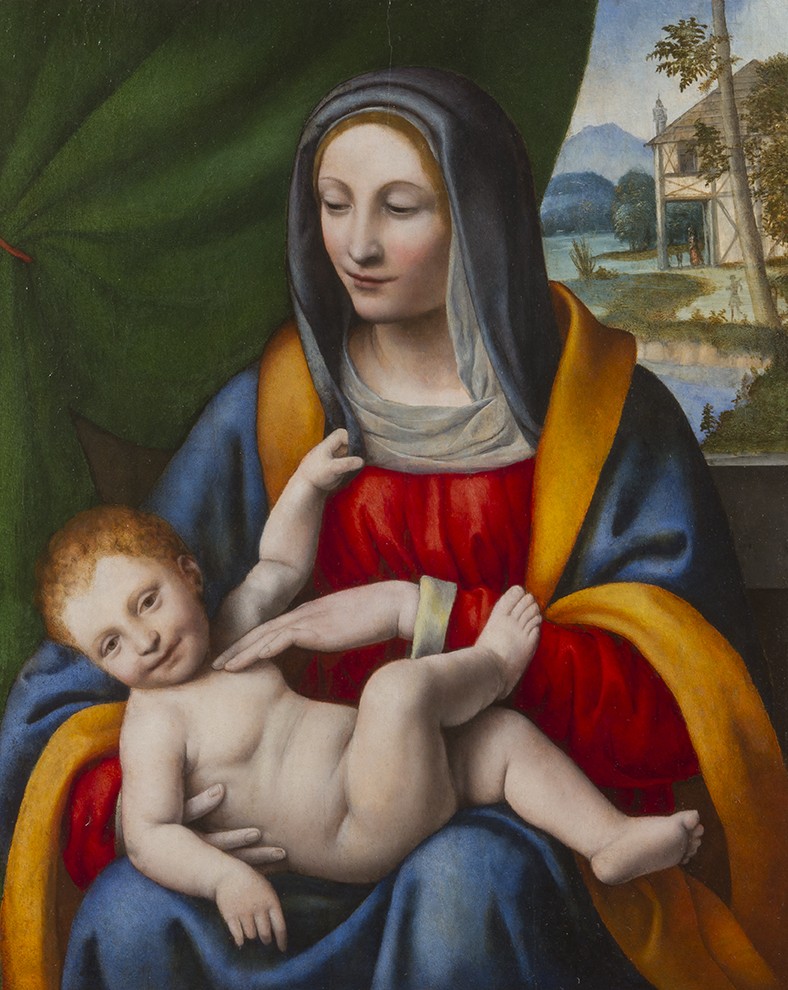
Bernardino Luini
(Dumenza 1480/1482 - 1532 Milan)
Madonna and Child, c. 1520
oil on panel, 68 x 55 cm (26.77 x 21.65 inches)
Bernardino Luini
(Dumenza 1480/1482 - 1532 Milan)
Madonna and Child, c. 1520
oil on panel, 68 x 55 cm (26.77 x 21.65 inches)
Re: 939
Provenance
Milan, Litta Modigliani collection
Literature
A. Annoni, Un quadro poco noto di Bernardino Luini, in “Rassegna d’arte”, I, 1901, 10, pp. 156-157
L. Beltrami, Luini 1512-1532. Materiale di studio raccolto a cura di Luca Beltrami, Milan, 1911, pp. 525, 536, 614
W. Suida, Leonardo e i leonardeschi (1929), Italian edition edited by M. T. Fiorio, Vicenza, 2001, p. 274
A. Ottino della Chiesa, Bernardino Luini, Novara, 1956, pp. 34, 118, no. 168
B. Berenson, Italian Pictures of the Renaissance. Central Italian and North Italian Schools, I, New York, 1968, p. 233
L. Tognoli, in Sacro e profano nella pittura di Bernardino Luini, Cinisello Balsamo, 1975, pp. 102-103, no. 114
J. Ingamells, The Wallace Collection. Catalogue of Pictures, I, British, German, Italian, Spanish, London, 1985, p. 309
The painting is an autograph work by Bernardino Luini, one of the leading painters of the Lombard Renaissance
Probably executed at the height of his career, it is one of the most original versions of a subject frequently treated by the artist, and also an excellent example of that suave, engaging manner which in the nineteenth century made it an unsurpassed model of Purist stamp.
The Virgin is seated with a shawl over her head, a red robe and a blue mantle lined with orange; with her left hand she touches the chest of the Child, who lies on her lap, kicking his legs and smiling. In the background, on the right, a green drape opens onto a sheet of water and mountains. For this airy backdrop there is no need to invoke the artist's Venetian training, since it was a motif widespread in Lombardy too (Foppa, Bergognone) and among the Milanese Leonardesque painters (Solario, Rizzoli, and others). A green curtain drawn back over a landscape appears, for example, in the Madonna of the Apple in Brera, and in the Madonna and Child in the Galleria Borghese by Giampietrino. Here, dominating the background, is a house with crossed half-timbering and a wooden portico, a type of rural building very common north of the Alps that would not have been out of place in the Lombard countryside either. Luini also depicts it in the frescoes of the Villa Pelucca (Death of the Firstborn) and, still more similar, in the Mockery of Cam (both works are in Brera), where the house has the same portico but the construction is of linear half-timbering
The face of the Virgin, with its arched eyebrows, strong cheekbones and tapering chin — a synthesis of a Raphaelesque and Leonardesque type — is one of the recurring morphologies in the painter's work (for example in the Magdalene in Washington). The vivid range of colours (emerald green, blue, vermilion red, orange-yellow), applied with an enamel-like effect and delicate chiaroscuro transitions, is typical of Luini and of Lombard painting of the first half of the sixteenth century. The hand touching the infant's breastbone in profile, with the little finger bent, is a stylistic device derived from hands in prayer, which can be seen, among other works, in the Virgin of the youthful Lamentation in Budapest; the lively pose, with the smiling Child, reflects the enormous impact of Leonardo's expressive "motions" on the local school. The little Jesus laughing, not a very frequent motif, is an expression well suited to the painter (the Christ Child with a Toy in Peterborough, for example), which he always softens within the bounds of decorum. As Giovanni Agosti has noted (Bernardino Luini e ai suoi figli, Trento, 2014, p. 260), in Luini's work the expressive Leonardesque dynamism almost always ends up resolving itself into a pose; that is, it is a way of animating the scene on the part of a painter devoted to composure. While the child playing with the drapery recurs in the Madonna in the Liechtenstein Palace, Vienna, the artist reuses the unusual motif of the crossed right leg at least once more in the Madonna and Child formerly in Philadelphia, which appeared at Christie's in New York in 1989 (Quattrini, 2019, no. 100). In particular, the competition is with the kicking infants of Solario (Madonna of the Green Cushion in the Louvre, Nursing Madonna in the Poldi Pezzoli) and with a similar solution in Bramantino (Holy Family of Carzago Riviera, Martes Sorlini Museum collection). The painting can be connected to a series on the same subject (often with the addition of the young Saint John) that the artist conceived in the first half of the 1520s (Quattrini, 2019, nos. 82-85). As has already been noted, the most direct comparison is with the Madonna and Child in the Wallace Collection in London (ibidem, no. 123). The London panel is very similar in colour range and composition, with the landscape window on the right, the hand touching the Child's chest and the ivory-like rendering of the flesh tones. The two works appear to have been executed at a considerable distance in time. It is reasonable to place them after the masterpieces of San Giorgio in palazzo in Milan and the already-mentioned Lamentation in Houston, executed around the middle of the second decade, but not very far into the third, that is, around 1520 or a little later, in a phase in which the artist was settling his own pictorial language and beginning an important production of small-scale paintings for private devotion.