

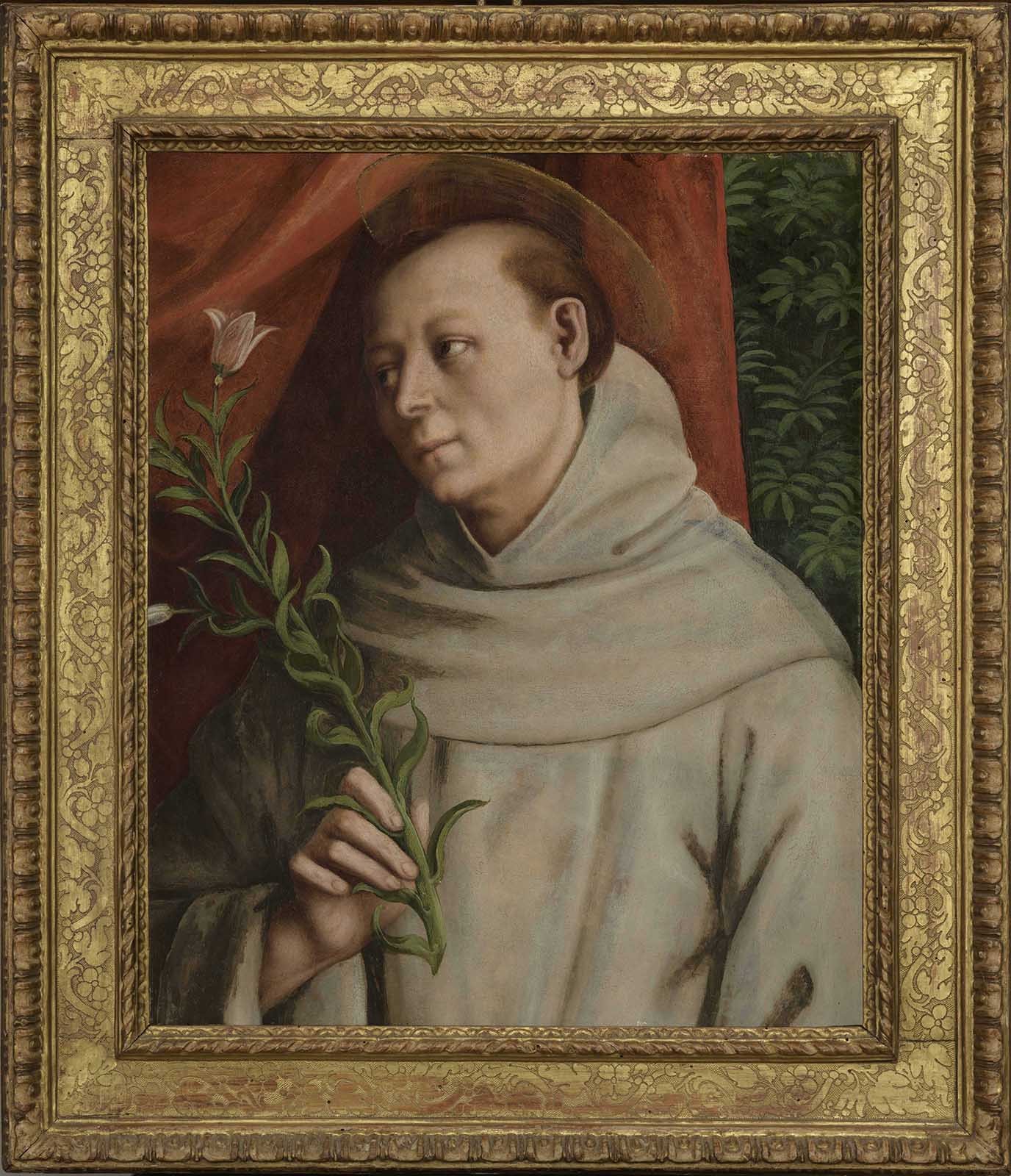
Gaudenzio Ferrari
(Valduggia 1475 - 1546 Milan)
Saint Anthony of Padua, c. 1538
oil on panel, 60 x 51 cm (23.62 x 20.08 inches)
Gaudenzio Ferrari
(Valduggia 1475 - 1546 Milan)
Saint Anthony of Padua, c. 1538
oil on panel, 60 x 51 cm (23.62 x 20.08 inches)
Re: 942
Provenance
Milan, church of Santa Chiara, until 1782
Milan, Giovanni Battista Monti (died 1830), from 1782
London, Cornelius Marshall Spink (1904–1990), 1964
Lombardy, Giovanni Testori collection
Piedmont, private collection
Essential Literature
A. Santagostino, L'immortalità e gloria del pennello. Catalogo delle pitture insigni che stanno esposte al pubblico nella città di Milano, Milan 1671, p. 61
N. Sormani, De' passeggi storico-topografico-critici nella città, indi nella diocesi Milano, Milan 1751–1752, vol. III, p. 176
G. Romano, in Bernardino Lanino, exhibition catalogue edited by P. Astrua and G. Romano, Milan 1985, p. 104;
F.M. Ferro, Un'ancona milanese di Gaudenzio, in «Paragone», 419-423, 1985, pp. 156-163
R. Sacchi, entry Ferrari, Gaudenzio, in Dizionario Biografico degli Italiani, vol. 46, 1996, p. 578
G. Romano, in Il Rinascimento nelle terre ticinesi. Da Bramantino a Bernardino Luini, exhibition catalogue edited by G. Agosti, J. Stoppa and M. Tanzi, Milan 2010, p. 228
R. Sacchi, Gaudenzio a Milano, Milan 2015, pp. 137-139
F.M. Ferro, in Il Cinquecento lombardo. Da Leonardo a Caravaggio, exhibition catalogue edited by F. Caroli, Milan 2000, pp. 419-421
F. Nurchis, in Il Rinascimento di Gaudenzio Ferrari, exhibition catalogue edited by G. Agosti and J. Stoppa, Milan 2018, pp. 467-473 (with complete bibliography)
The panel is an important piece in the artistic development of Gaudenzio Ferrari, since it originally formed part of the altarpiece painted by the artist for the church of Santa Chiara in Milan.
This religious foundation, entrusted to the Observant Poor Clares from the mid-fifteenth century, was closed following the Napoleonic suppressions of 1782, and the following year was absorbed into the new building of the Monte di Pietà. Little or nothing survives of its rich artistic heritage, with the exception of Gaudenzio's altarpiece and a cycle of fifteenth-century frescoes detached from the claustral area (the section reserved for the nuns) at the end of the nineteenth century1.
The history of Gaudenzio's panel was carefully reconstructed on the occasion of the monographic exhibition devoted to the artist in 2018, held in Varallo, Vercelli and Milan.
Seventeenth- and eighteenth-century sources describe the altarpiece on the high altar of the outer church, depicting the Virgin and Child flanked by Clare and Saint Anthony of Padua2. On 28 March 1782 the suppression of the church was ordered, and a few days later the panel was purchased by Giovanni Battista Monti, an interesting collector who took an early interest in the works of the so-called "primitives." He was also administrator to Giberto V Borromeo, assisting him with acquisitions for his picture gallery; on his death in 1830, he stipulated that his private collection should pass into the Borromeo collection3.
In 1785, while still in Monti's possession, the painting was broken up into four parts by the Milanese restorer Carlo Tagliabue, perhaps owing to the poor condition of the wooden support4. The main element, the Madonna and Child, was altered into an arched shape and sold to Count Giacomo Carrara; on the latter's death it passed into the collections of the Accademia di Bergamo, where it remains today5.
The two delicate crown-bearing angels, once placed above the Virgin, remained in the Monti collection, subsequently entering the Borromeo collection and then that of the Pesenti Pigna heirs. The Saint Clare, reduced to a half-length figure, reappeared in 1821 in the collection of Gaudenzio Bordiga, a man of letters and engraver from the Valsesia to whom the modern reassessment of Gaudenzio Ferrari owes its beginning6.
Of the Saint Anthony of Padua, by contrast, all trace was completely lost, so much so that Gustavo Frizzoni, in 1890, taking stock of the surviving elements of the Milanese altarpiece, stated that that fragment "had perished, the wood having rotted"7. The panel unexpectedly resurfaced in 1964, in an advertisement placed by the London art dealer Cornelius Marshall Spink8.
For the beginning of its critical reassessment, however, one must wait until 1985, when Giovanni Romano mentioned it in passing in the catalogue of the monographic exhibition devoted to Bernardino Lanino, hypothesizing that it belonged to an altarpiece similar to the one from which Lanino's Saint Francis and Saint Clare today in the Pinacoteca of the Accademia Albertina in Turin, derive9. In the same year Filippo Maria Ferro published in "Paragone" a first reconstruction of Gaudenzio's altarpiece, associating with the Madonna in the Accademia Carrara the Saint Clare and the angels in a private collection, and proposing a dating for the work around 1536-153710. Shortly afterwards the scholar succeeded in also tracing to the dismembered complex the Saint Anthony, traced with the help of Giovanni Testori; this latest acquisition is recorded by Rossana Sacchi in the entry devoted to Gaudenzio in the Dizionario Biografico degli Italiani11.
To Sacchi herself we owe a careful analysis of the context of the commission, to be sought in the "crowded community of nuns and lay sisters" that animated the church of Santa Chiara in the 1530s. Many of these women belonged to leading families, such as the Vimercati, the Aliprandi, the Lampugnani and the Gallarati. It was above all, however, the Carcano family who maintained close ties with the religious foundation, also owing to the particular devotion practised in the convent towards the Blessed Michele Carcano (1427-1484), who had been among the founders of the Monti di Pietà. His niece Angela Caterina Carcano was a Poor Clare and in 1536 held the office of abbess. The senator and jurist Girolamo Carcano, brother of Sister Angela, was involved in the administration of the convent. It is therefore likely that it was to this very family that Gaudenzio's altarpiece owed its placement in the position of greatest prestige in the church, namely on the high altar, and that it is stylistically datable to around 1537-1538.
The work holds particular importance in the artistic development of Gaudenzio Ferrari also because it represents the first surviving painting of his Milanese phase.
Documented in the city from 21 March 1537, the artist initially worked for the Fabbrica del Duomo, acting as technical consultant for the opening of a new doorway in the left transept of the building. Between 1537 and 1541 Ferrari also supplied the Cathedral with some cartoons for a series of tapestries depicting Stories of the Virgin, unfortunately now lost12.
The commission for the Santa Chiara altarpiece confirms the close ties maintained by Gaudenzio with the Observant Franciscans, a bond rooted in the great building project of the Sacro Monte di Varallo but which remained particularly significant also for the master's mature phase13.
1 These frescoes with Stories of the Passion, datable to the 1470s, currently belong to Intesa Sanpaolo (UBI Banca collection) and were exhibited in 2021 at the Museo Diocesano in Milan, together with three stone keystones likewise coming from the claustral church.
2 See for example Santagostino 1671, p. 61 (which, however, erroneously identifies Saint Anthony of Padua with Saint Bernardino) and Sormani 1751-1752, III, p. 176.
3 La Pinacoteca Borromeo-Monti, in Capolavori da scoprire. La collezione Borromeo, exhibition catalogue edited by A. Di Lorenzo, M. Natale, Milan 2006, pp. 40-56.
4 Nurchis 2018, p. 470.
5 The fragment was restored to its rectangular shape by a restoration carried out in 2015.
6 G. Bordiga, Notizie intorno alle opere di Gaudenzio Ferrari pittore e plasticatore, Milan 1821, p. 43. Left by Bordiga to the Seminario d'Adda in Varallo, the Saint Clare later passed to the d'Adda family and remains today in a private collection. On the figure of Bordiga, see the recent study by S. Amerigo, La figura di Gaudenzio Ferrari nella storiografia artistica ottocentesca: le ricerche di Gaudenzio Bordiga e le stampe di traduzione di Silvestro Pianazzi, Turin 2020.
7 G. Frizzoni, Il museo Borromeo in Milano, in «Archivio Storico dell'Arte», III, 1890, p. 357; in the text of the Bergamask connoisseur the erroneous identification of the saint with Bernardino persists, which, as we have seen, originated in the description of the work provided by Santagostino in 1671.
8 «Apollo», LXXX, n.s., 30, 1964.
9 Romano 1985, p. 104.
10 Ferro 1985. This dating is considered somewhat too early by Romano 2010, p. 228.
11 Sacchi 1996, p. 578.
12 Sacchi 2015, pp. 28-29.
13 Ibidem.