

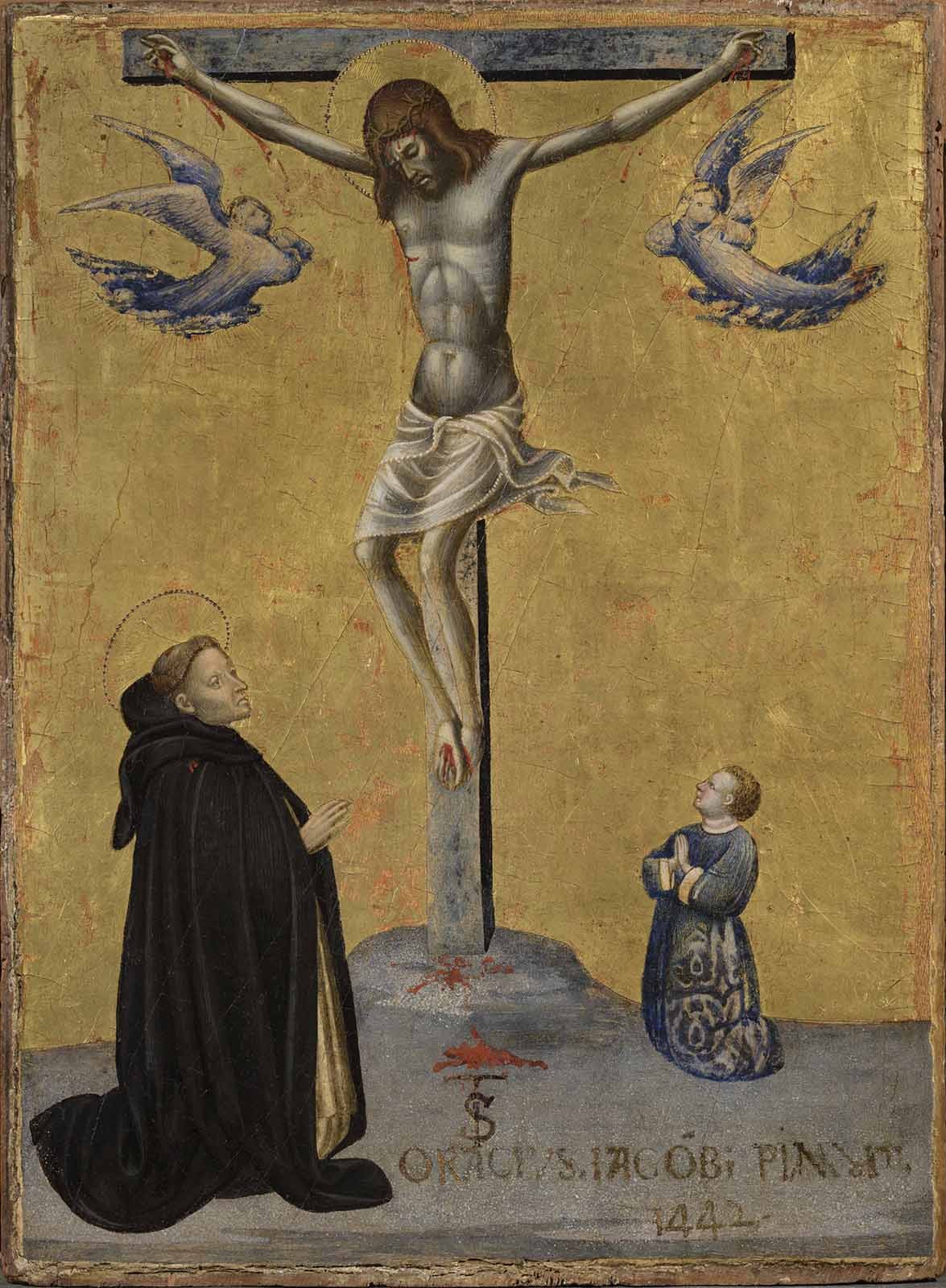
Orazio di Jacopo
(Bologna c. 1385 - 1449 Bologna)
Crucifixion with Saint Peter Martyr and a Donor, 1442
tempera on panel, gold ground, 52 x 37 cm (20.47 x 14.57 inches)
Orazio di Jacopo
(Bologna c. 1385 - 1449 Bologna)
Crucifixion with Saint Peter Martyr and a Donor, 1442
tempera on panel, gold ground, 52 x 37 cm (20.47 x 14.57 inches)
Re: 944
Signed and Dated
Oracius Jacobi pinxit 1442
Provenance
Bologna, Gozzadini collection (1810-1887)
Bologna, Gozzadini hairs, until 1906
Bologna, galleria Rambaldi. lot 115
Sarzana, Podestà Lucciardi collection (until 1909)
Venice, Alvise Schio collection
Wannenes, Genoa, 5 March 2020, lot 969 (€ 162,600)
Literature
S. Bottari - C. Volpe, La pittura in Emilia nella prima metà del Quattrocento (dispense universitarie a.a. 1957-1958), Bologna, 1958, pp. 73-76
M. Medica, Orazio di Jacopo, in La Pittura in Italia. Il Quattrocento, a cura di F. Zeri, Milano, 1987, II, p. 720
C. Volpe, Orazio di Jacopo, in La Pittura nell’Emilia e nella Romagna. Raccolta di scritti sul Trecento e Quattrocento, Modena, 1993, pp. 90 - 92, ill. 172
W. Garau, Giovanni Gozzadini (1810 - 1887) e la sua collezione d’arte, tesi di laurea in Storia dell’arte Medievale, Università degli Studi di bologna, Facoltà di Lettere e Filosofia, relatore prof. Daniele Benati, anno accademico 2010/2011, pp. 143-145, Tav. XIX
M. Minardi, Orazio di Jacopo, in Dizionario Biografico degli Italiani, 2013, vol. 79
V. Mosso, Una tavola poco nota del quattrocento bolognese, in Intrecci d’arte, n. 3, 2014, pp. 5 - 13
Fototeca Zeri
n.28448
Painting declared to be of Italian particularly important artistic and historical interest
As for Orazio di Jacopo, son of the painter Jacopo di Paolo, one must reckon with a catalogue of securely attributed works that is rather sparse, owing to losses and dispersals. Registered with the Guild of the Four Arts in Bologna in 1410, the artist is documented as having pursued a multifaceted career. He was active not only as a painter (paid, as was often the case, for painting signs, coats of arms, banners, etc., on the occasion of civic festivities and solemnities), but also involved in the making of furniture—such as a wooden cupboard for the church of San Giacomo Maggiore in 1432—and even served as overseer of fortifications and engineer for the construction works of San Petronio. Not to mention his appointments, both responsible and of some prestige, within the civic administration of Bologna.
Two polyptychs signed by Orazio and seen by Carlo Cesare Malvasia are now lost—one, dated 1438, was in the women’s infirmary of Santa Maria della Morte, the other in the cathedral of San Giovanni in Persiceto. Remaining is the Crucifixion, signed Oratius quondam Jacobi pinxit, today in the Museo dell’Osservanza in Bologna (formerly in San Paolo in Monte dell’Osservanza), which is generally dated shortly after the death of his father, Jacopo di Paolo, who passed away between 1429 and 1430. In a private collection survives the last known record of Orazio’s pictorial activity: a panel painting of Bernardino of Siena, completed in 1445, one year after the friar’s death, at which time he was already surrounded by the aura of sanctity that the Church would officially acknowledge only in 1450.
We may also recall Renzo Grandi’s opinion (La pittura tardogotica in Emilia, in La pittura in Italia. Il Quattrocento, Milan, 1987, vol. I, pp. 222–239, esp. p. 227), who identifies the “modest but highly refined” Madonna in a Landscape, on display in the Collezioni Comunali d’Arte in Bologna, as the central panel of the polyptych painted by Orazio in 1438, remembered in the seventeenth century by Canon Malvasia (Le pitture di Bologna, 1686, ed. A. Emiliani, Bologna 1969, pp. 166, 168).
The original destination of the small panel here under examination was in all likelihood private, as suggested by its modest dimensions. Unfortunately, no definite clues allow us to identify the young nobleman depicted in prayer at the foot of the Crucifix—unless the interlaced initials T S above the painter’s signature offer a hint to his identity. This constitutes tangible evidence of private devotion, of a lay patron of high social standing engaged in “domestic prayer”, such as can be reconstructed in Bologna from, for example, the inventory of the estate of the late Andrea Battaglia, dated 13 October 1455, which lists various (now lost) “anchone” or sacred images on wood or even on canvas displayed throughout his home (C. Cavalca – I. Negretti, Dentro il Rinascimento italiano: le scelte di Andrea Battaglia [Bologna, ante 1431–1455], in Art et Renovatio, 6 [2019], pp. 3–30, esp. pp. 16–25).
This painting thus predates by three years the San Bernardino formerly in San Paolo al Monte all’Osservanza in Bologna, yet it does not yet reveal, as that painting does, “the elementary and somewhat inert mental rigour which, at such a late date, signals the artist’s evident disorientation, alongside a harsh desire for formal simplification” (Grandi 1987, p. 277). This disorientation was brought about by the inexorable shift in taste among Bolognese patrons towards the proper Renaissance, compelling Orazio to keep pace with the times without betraying his own visual language, still deeply rooted in the late Gothic tradition inherited from his father, Jacopo di Paolo, and shared with his brother-in-law Michele di Matteo.
This effort is already evident in the present work: a comparison with the aforementioned Crucifixion in the Museo dell’Osservanza reveals fewer explicit references to Giovanni da Modena, particularly evident in that panel in the broad and sinuous movement of the draperies and in the strong expressive emphasis of the faces. The “mental rigour” identified by Grandi as a hallmark of the 1445 panel is, to be fair, already perceptible here, though in far less elementary and by no means inert forms.